BIGGEST GUIDE TO HORNBILL FESTIVAL, KISAMA NEAR KOHIMA – OFFBEAT NAGALAND, INDIA!
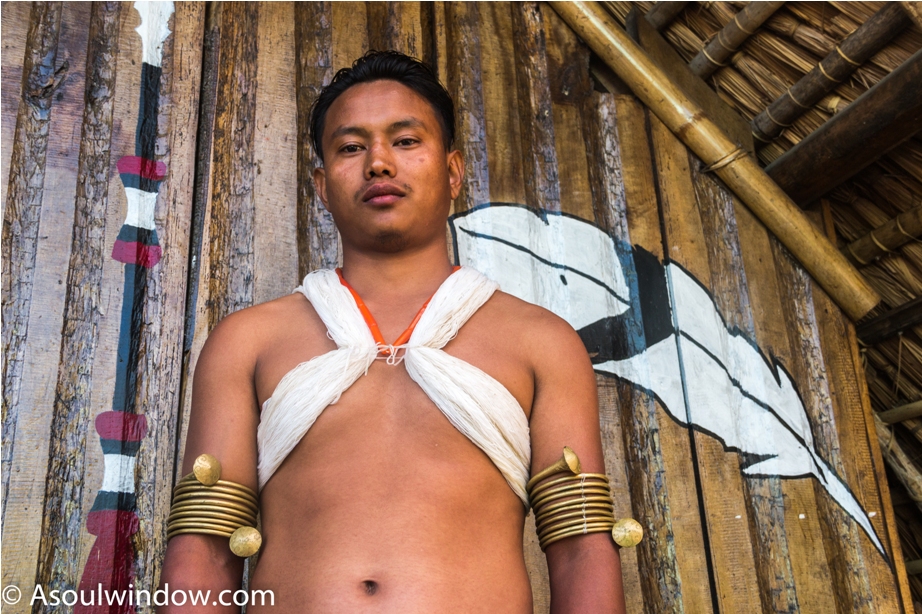
A Naga man outside Zaliang Morung. At Hornbill festival, Kisama. Near Kohima, Nagaland, India!
WHAT IS HORNBILL FESTIVAL ALL ABOUT?
Ever since I started traveling in 2008, I had wanted to visit the HORNBILL FESTIVAL at Kohima in Nagaland, one of the seven sisters in the remote North East part of India. It was not so easy for me to make it for the Hornbill Festival since I worked in Mumbai and was a strictly budget traveler (No flights). And it happens just once the year.
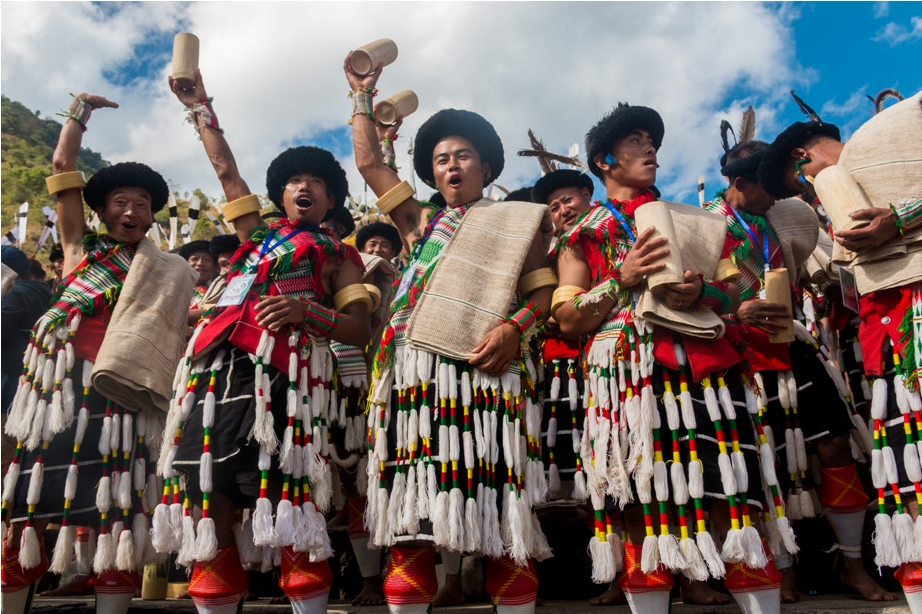
The audience cum performers at Hornbill festival, Kisama. Near Kohima, Nagaland, India!
The will to visit Hornbill festival grew stronger around the year when they FIRED ME FROM MY JOB FOR TRAVELING TOO MUCH! Even after I was fired, I could not visit Hornbill festival due to many reasons, one of them being my traumatic struggle to gain a foothold in blogging. But, finally I was here.
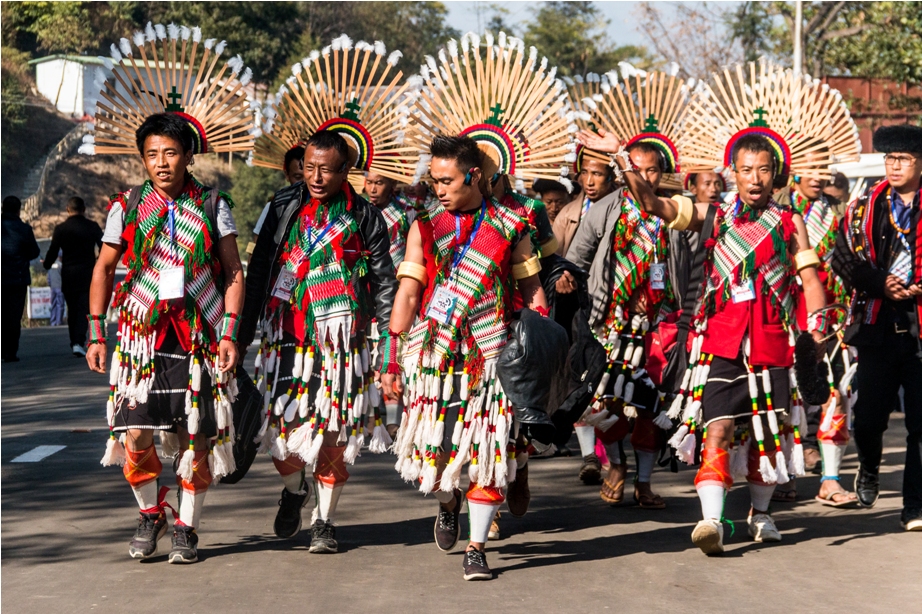
The streets be like this in At Hornbill festival, Kisama. Near Kohima, Nagaland, India!
FORMAT OF HORNBILL FESTIVAL, KOHIMA, NAGALAND
You can never get bored at the Hornbill Festival (except for the unending 18,264 choirs in the evening maybe! Yawn!) There is always so much happening in and around the festival grounds or the multi level designated areas for every tribe. Personally I enjoyed watching the tribes performing impromptu near their respective Morung.
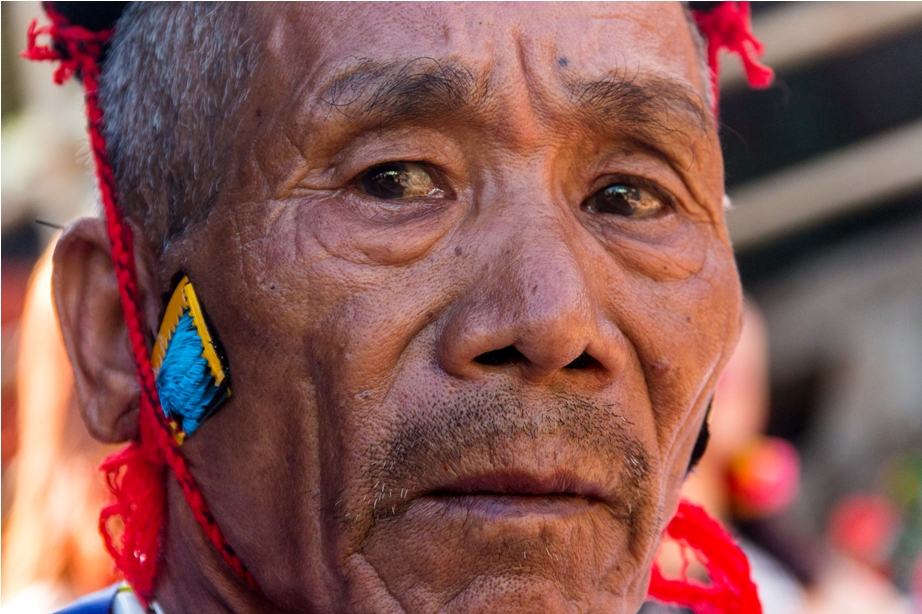
A Naga man at At Hornbill festival, Kisama. Near Kohima, Nagaland, India!
A Morung used to be bachelor’s dormitory in Nagaland where boys lived till they married. A visit to Morungs was more spontaneous and exciting to me than stage performers. It also allowed me to watch the performers with better proximity.
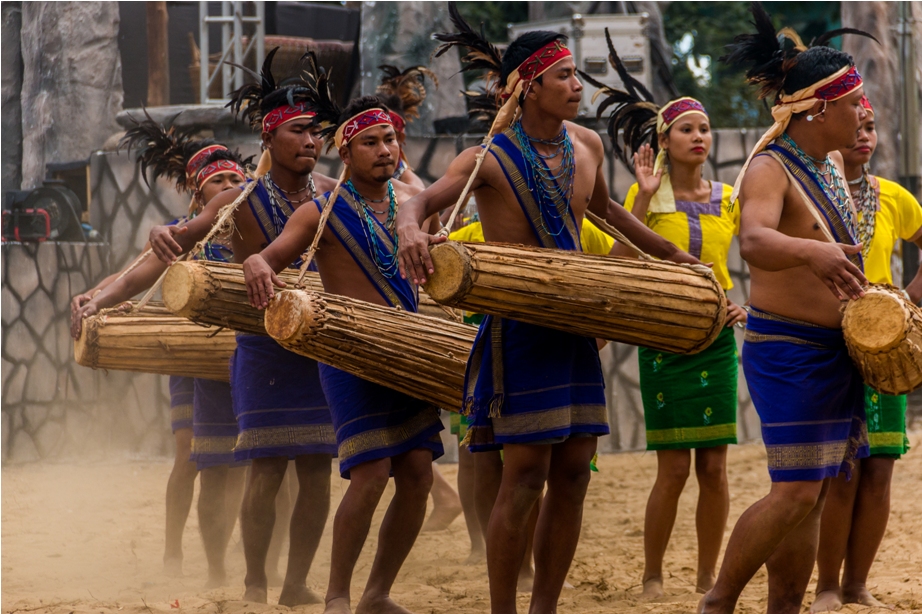
I loved the Wangala Dance by Garo Tribe. I loved the sound and movements, especially those of the leader. I can watch it all day! This picture is depicting the harvesting scene. At Hornbill festival, Kisama. Near Kohima, Nagaland, India!
The local cultural dances are performed at the festival ground which is akin to a large stadium. On one of the days, same dances and songs were performed twice a day, i.e, before the announcement of lunch and after it. Avoid one set of performances unless you really like something. Like, I did a repeat watch of the very eccentric and fun Wangla dance by the Garo Tribe.
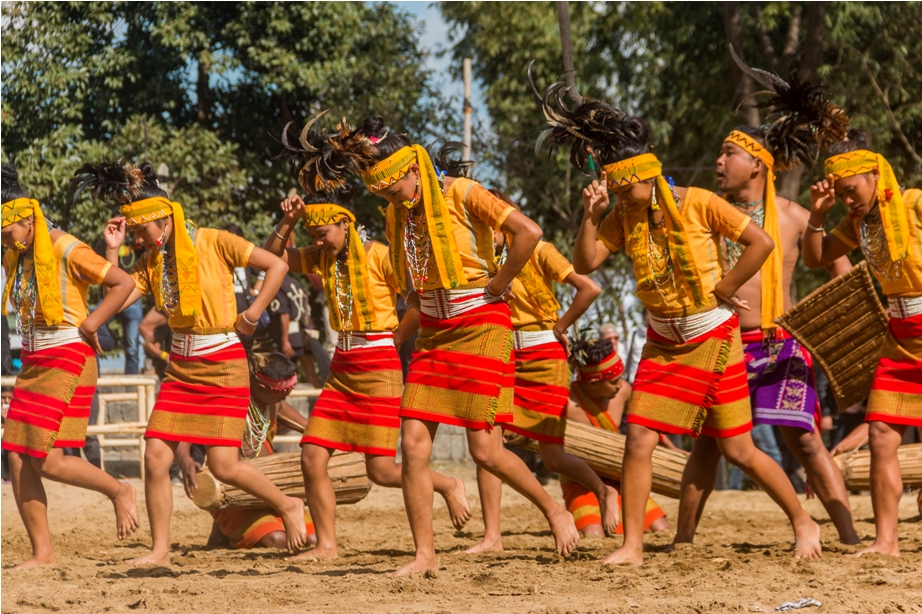
The superb Wangala dance by Garo tribe. My most favourite dance. At Hornbill festival, Kisama. Near Kohima, Nagaland, India!
Alternatively, you can have fun with shady people who are trying to convert you to an obeying Christian (meh!) or hang out at the shopping area, visit the World War Museum or the Horticulture area (Not to be mistaken with ‘Hottie Culture’, eh!) or chat with your friend over a tea/coffee/water/whatever or just hang out at one of the cool houses. Activities available here are endless.
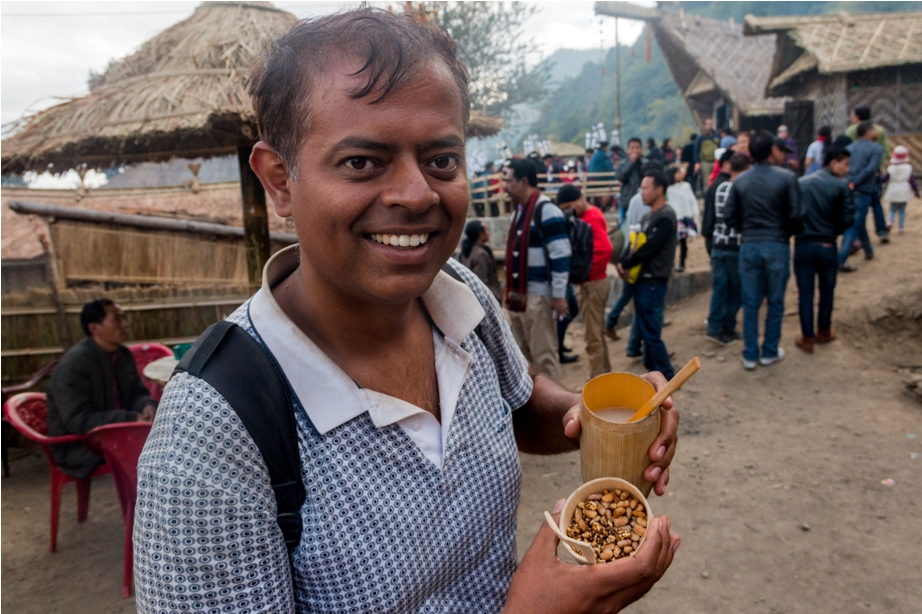
Me at one of the morungs wwith rice beer (Noooooooo!) and millets (Yes, yes, yes!) I loved this picture by: R Niranjan Das. At Hornbill festival, Kisama. Near Kohima, Nagaland, India!
You can pick the time table of the scheduled programs from the Information Desk (it is near the stadium) for free of cost. Once the dances by all the tribes at the stadium are over, you can stay around for some nice performances by local singers.
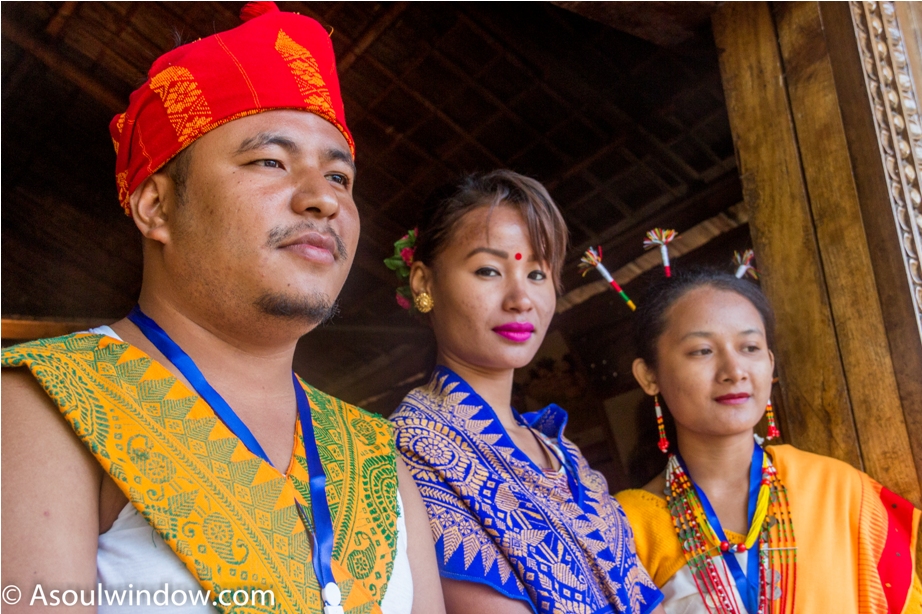
Members of Kachari tribe outside their Morung. At Hornbill festival, Kisama. Near Kohima, Nagaland, India!
Two girls, sitting next to us told us excitedly, “Hey, that is my friend singing!” It was immediately followed by, “Can you guys not talk and giggle for some time please!” I smiled and pulled out a chewing gum from my bag!
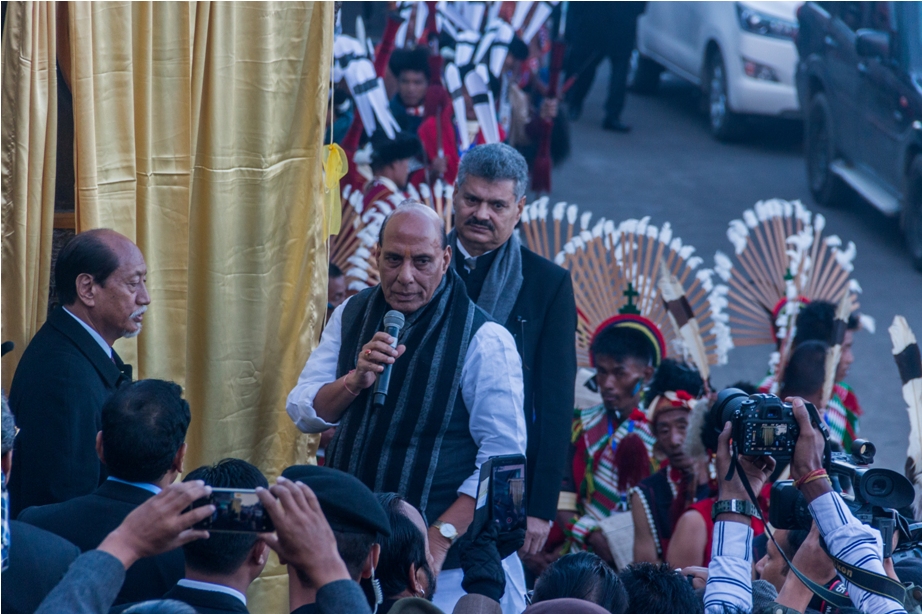
Indian Home Minister Shri Rajnath Singh at At Hornbill festival, Kisama. Near Kohima, Nagaland, India!
Avoid the mundane speeches by the authorities and Chief guests though. I was excited to see Indian home minister Mr. Rajnath Singh from close proximity.
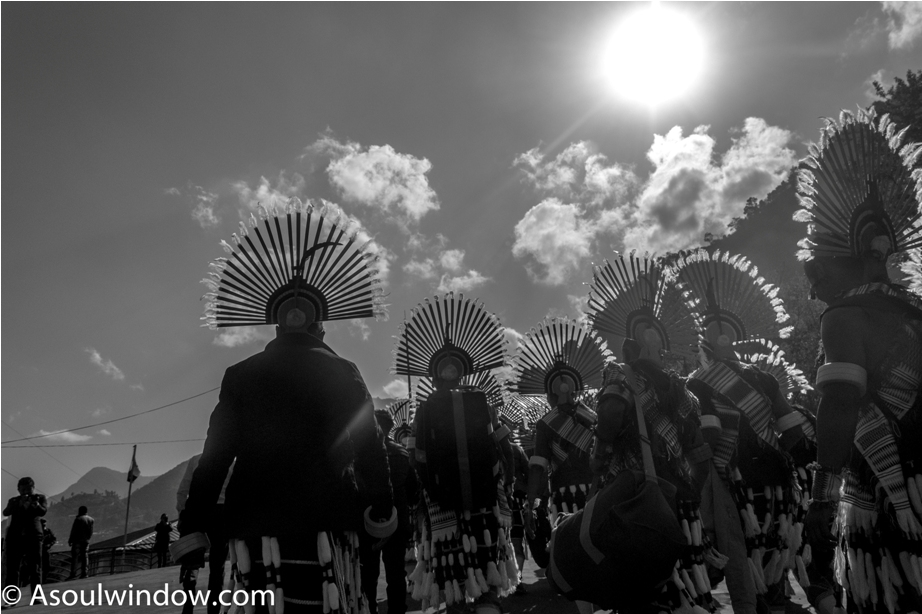
One of the tribes of Nagaland! At Hornbill festival, Kisama. Near Kohima, Nagaland, India!
SOUL WINDOW TIP: Morung was also a better vantage point for photographers. I would rather have a bamboo hut in the background than an ugly stage. But if you anyhow want to shoot the performances on stage and festival ground, go for the stairs near the seat of chief guest. Go earlier than others.
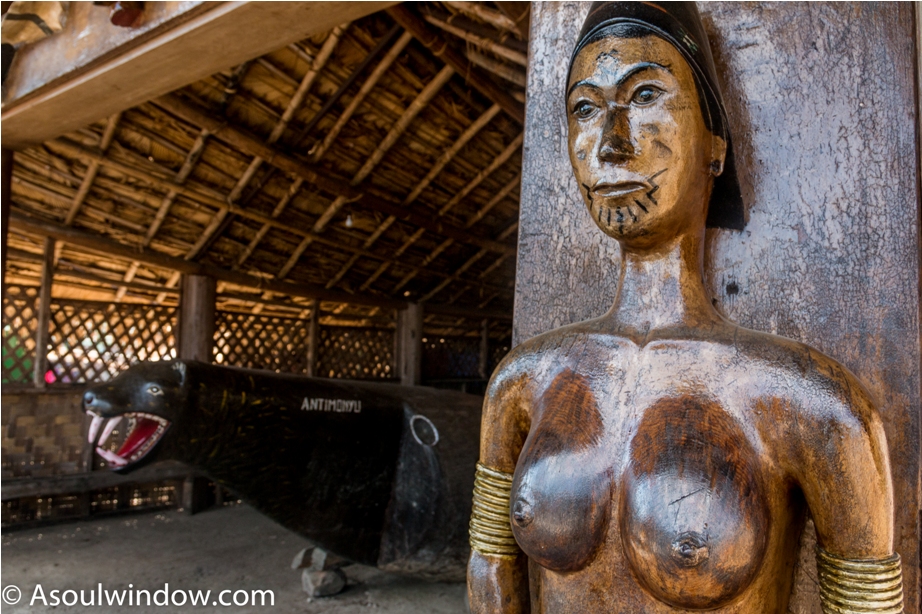
Chang Morung. At Hornbill festival, Kisama. Near Kohima, Nagaland, India!
VISIT THE MORUNG OF LOCAL TRIBES AT HORNBILL FESTIVAL, KOHIMA, NAGALAND
It is not easy to understand the various tribes of Nagaland, let alone those of the entire North East India! So, for someone who does not get to travel a lot, Hornbill festival is a great platform to understand the demographic diversity and to engage with the tribes directly.
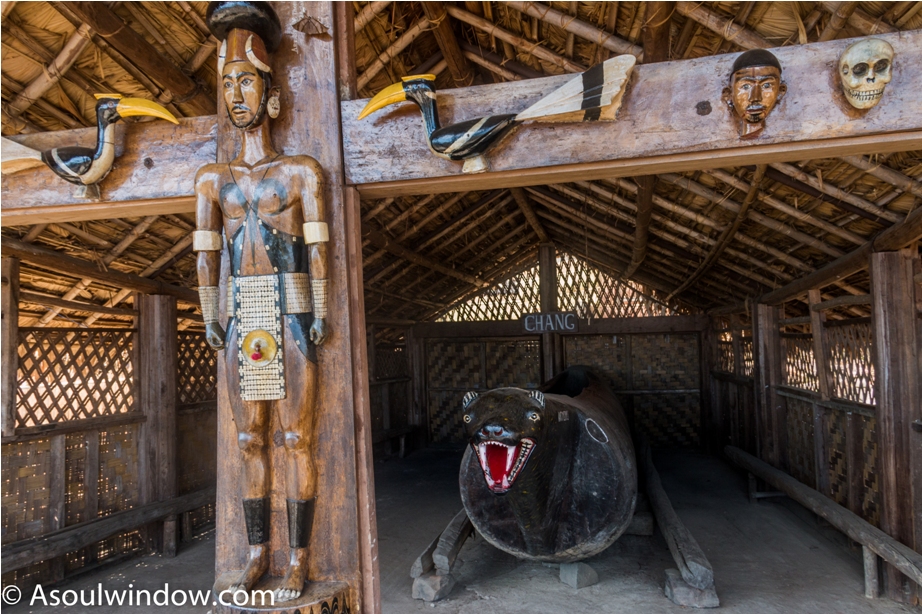
Chang Morung. At Hornbill festival, Kisama. Near Kohima, Nagaland, India!
Some people who have seen the festival over the years told me that Hornbill festival is losing its authenticity. I can-not compare since it was my first time at the Hornbill Festival, but I still found it to be authentic, exciting and devoid of brands’ blitzkrieg.
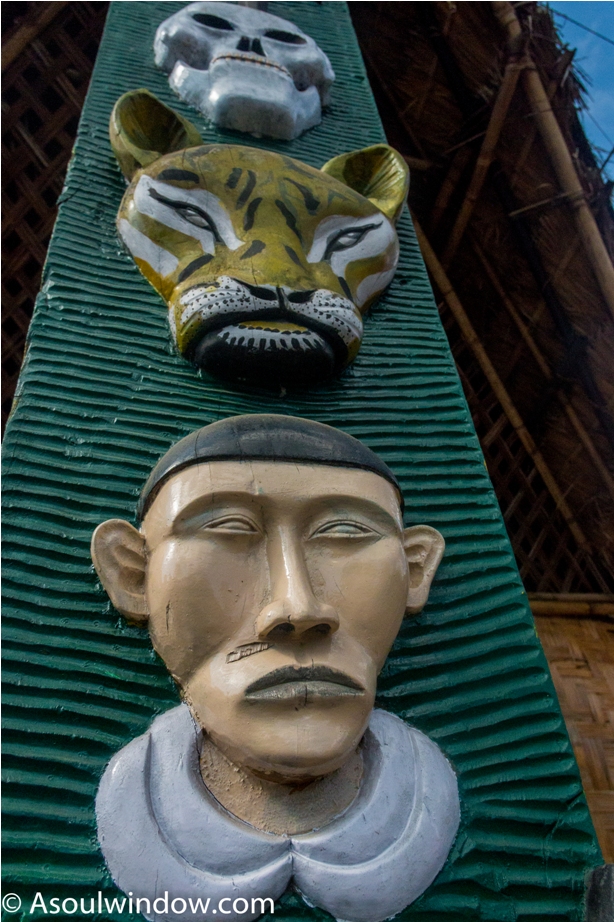
Sangtam Morung. At Hornbill festival, Kisama. Near Kohima, Nagaland, India!
Visiting the Morung of each tribe and later watching them perform gave me a good insight into the respective lifestyles of the different tribes. They were also very patient for selfie requests. Many times in a day, the tribe members would break into a song and dance in front of their Morungs. I enjoyed watching those ‘gigs’.
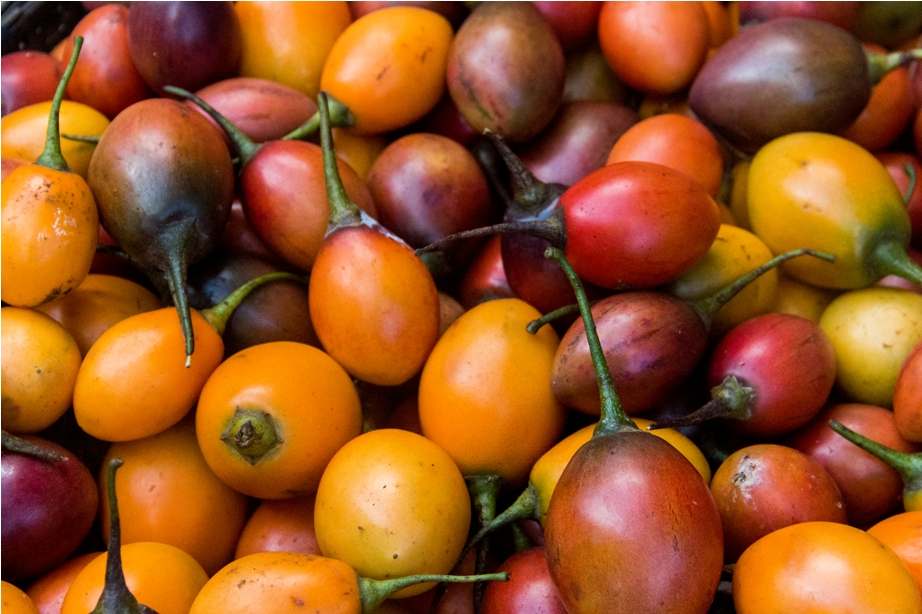
Quirky tomatoes which look like brinjals. At Angami Morung! At Hornbill festival, Kisama. Near Kohima, Nagaland, India!
You could even sample their food and drinks. I was particularly amused to see the quirky tomatoes which looked like small brinjals. The KonyakMorung even had a real rifle which you can shoot in the air for Rs. 100 for 1 shot! Who would have thought!
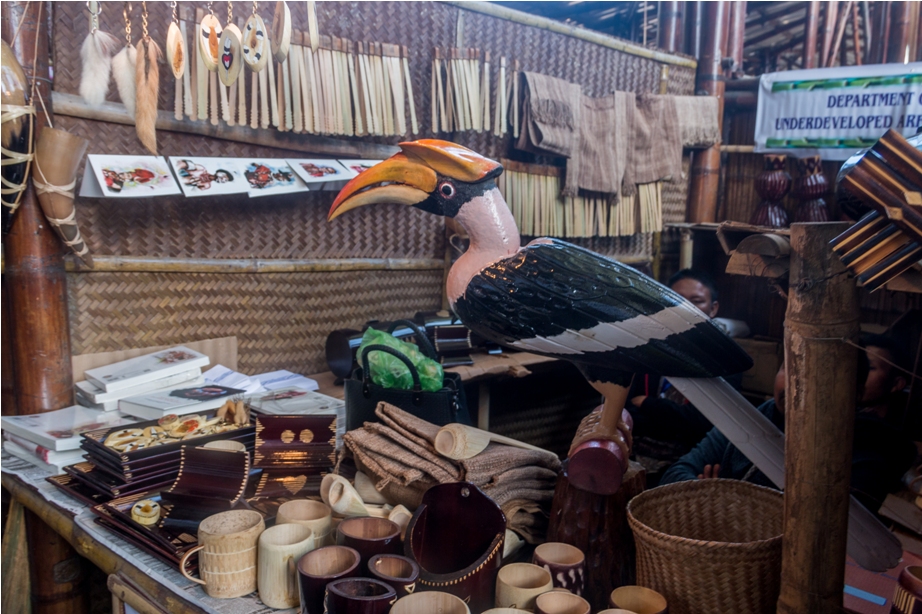
Shopping area at At Hornbill festival, Kisama. Near Kohima, Nagaland, India!
SHOPPING GUIDE: BUY LOCAL FOOD AND SOUVENIRS AT HORNBILL FESTIVAL, KOHIMA, NAGALAND
You can pick the jewelries, shawls, clothes, bags, even fruit juices (all of them a bit overpriced though) from almost all the Morungs of the tribes.
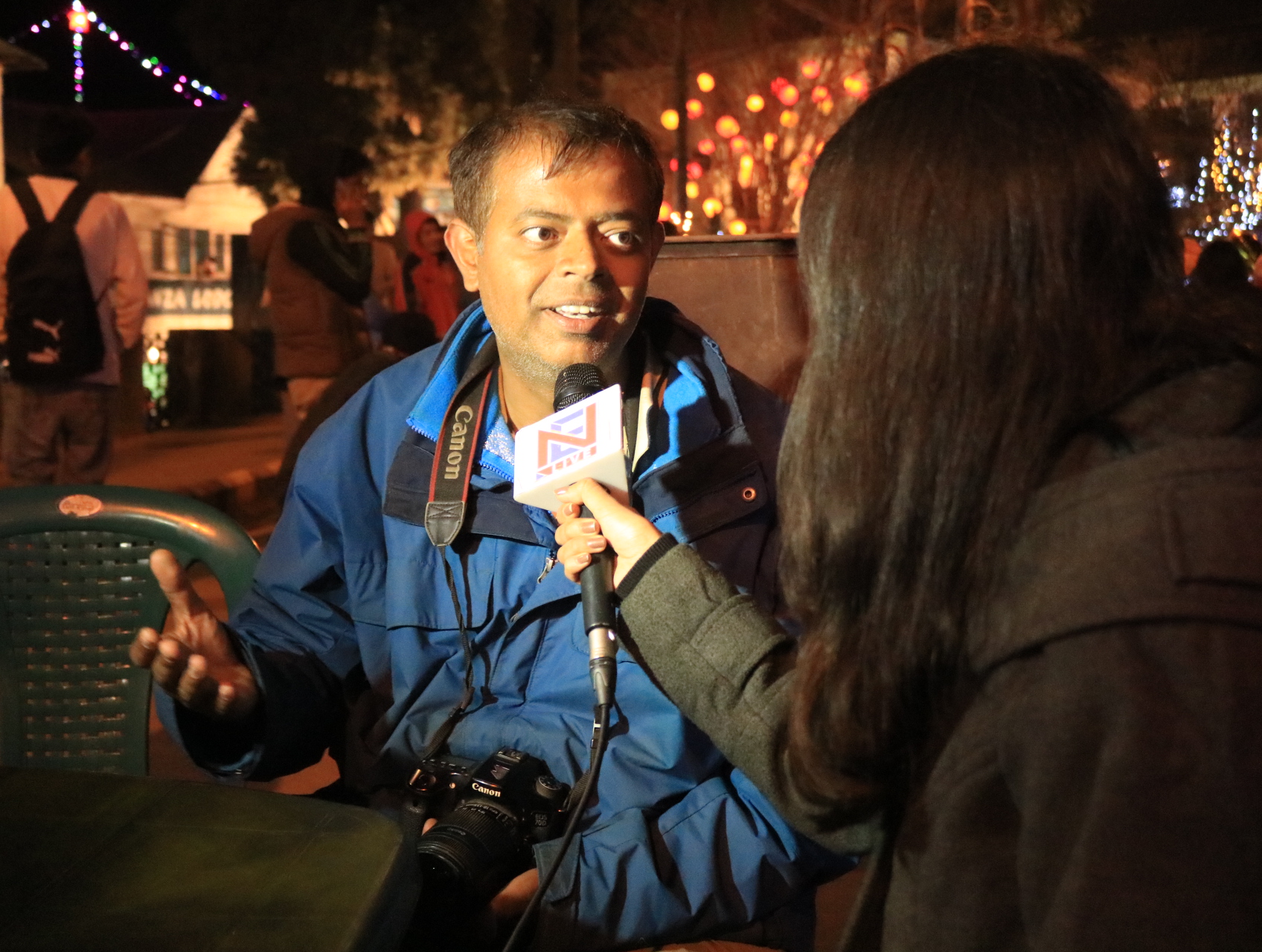
I was interviewed by a local TV channel about the festival at the night market in Kohima. At Hornbill festival, Kisama. Near Kohima, Nagaland, India! Picture by: Parnashree Devi
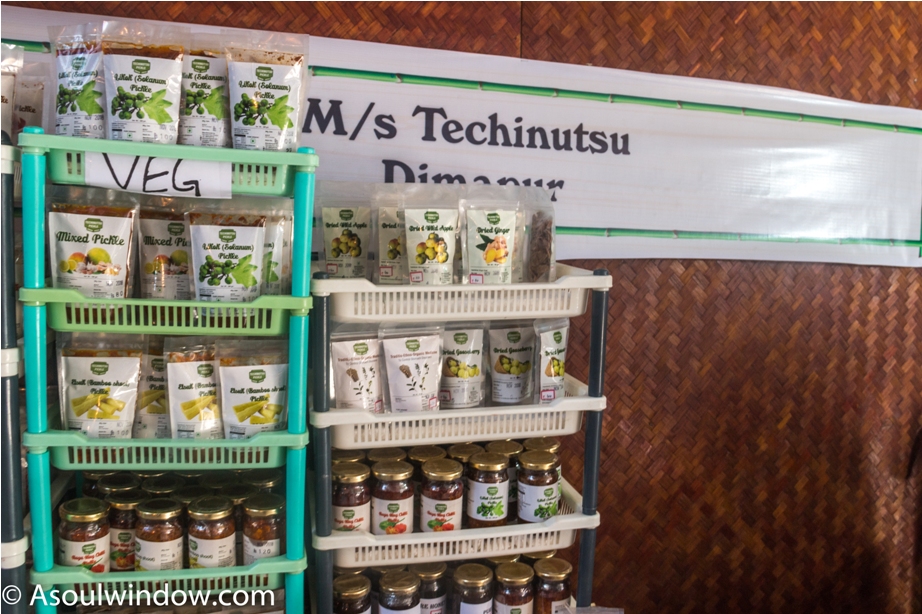
You can also visit the nearby shopping area to pick locally produced products. As usual, I picked up food souvenirs (Bhoot Jholakia Chutney) since I was traveling in North East India for 2 months on a stretch.
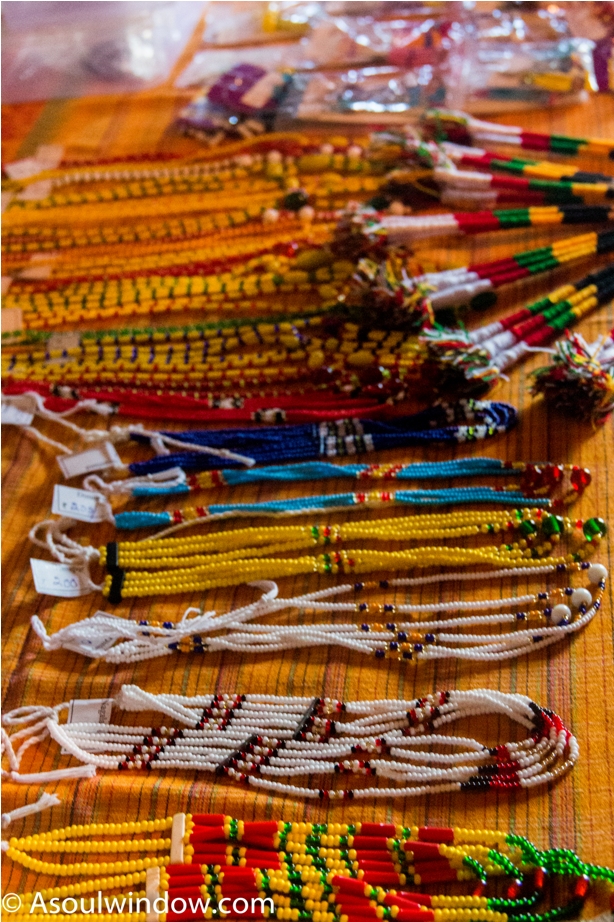
Tribal jewelleries for sale at the Kachari Tribe Morung. At Hornbill festival, Kisama. Near Kohima, Nagaland, India!
Some of the products I liked were bamboo cups, beer mugs, hornbill shaped merchandise, magnets, coasters, hats and Naga Shawls (Expensive for me at Rs. 3,000 per shawl) etc.
The girls could buy some offbeat tiaras or a show off necklace and other jewelleries which the local women wear.
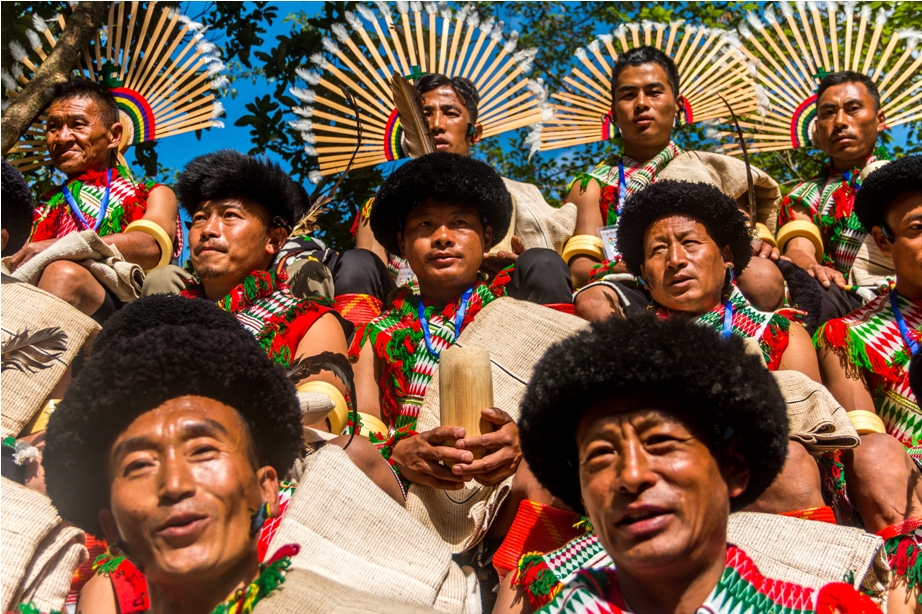
Just another day at At Hornbill festival, Kisama. Near Kohima, Nagaland, India!
LOCAL CULTURAL SHOW AT HORNBILL FESTIVAL, KOHIMA, NAGALAND:
Of all the performances I saw at Hornbill festival, I loved the Wangala dance by Garo Tribe the best. The music and the dance was quirky and seemed a bit too aggressive for a docile harvesting occasion. I was lucky to be able to watch that dance twice. Dances by other tribes were also equally rivetting. Dances by artists from other states like Chattisgarh, Rajasthan, Jammua and Kashmir were nice but did not fit in with the theme of all things Naga. I expected to see local performances only. Sporting events like Tug Of War was very exciting but a bit stretched. It could have been for a shorter duration. I (We) was most impressed by a women who made the audience speechless with her flawless acrobatics.
Soul Window Tip: Plan A trek to Dzukou Valley. It is very close to Kisama. Ask around and find a company. The trek is only 3 hours long (One way) Stay overnight for amazing sun set.
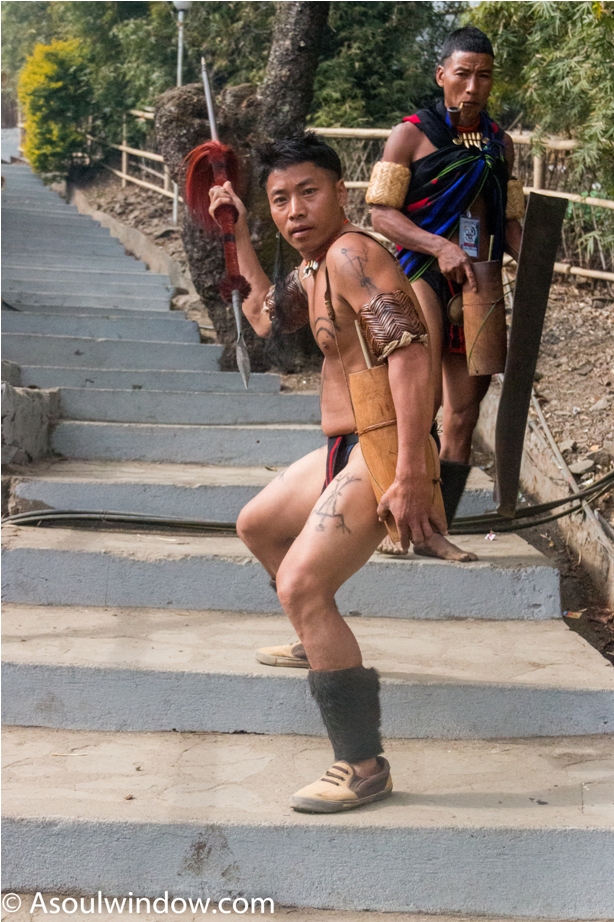
Warriors galore! Watch your steps at Hornbill festival, Kisama. Near Kohima, Nagaland, India!
HOW ECO FRIENDLY HORNBILL FESTIVAL AT KOHIMA IS?
I LIKED THEIR intention but still it failed to match my expectations which Bas Con aka Basar Confluence had set with 100 % compliance to eco friendliness. I have a green thumb so I was happy when the ‘plastic police’ at Bas Con politely asked the travelers to leave their plastic bottles at the entry gate. But they did not offer any alternative. For example, folks at the Bas Con gave us a bamboo tumbler every time they took away a plastic bottle.
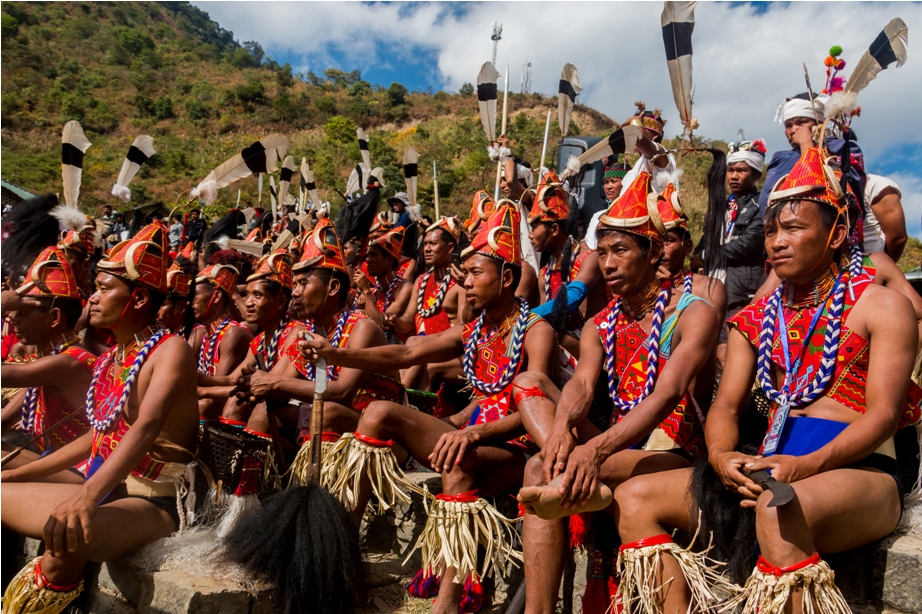
The tribes at the festival ground at Hornbill festival, Kisama. Near Kohima, Nagaland, India!
We could refill the tumblers (with water or local beer-will you ever behave?) from refilling stations across the festival grounds. Something like this could have been implemented here. Yes, you can always carry metallic water bottles but in case you lose it or forget to bring it along, you will have to buy some food to get free water. I was lucky to have my campsite within the entry gate, so we never worried about water.
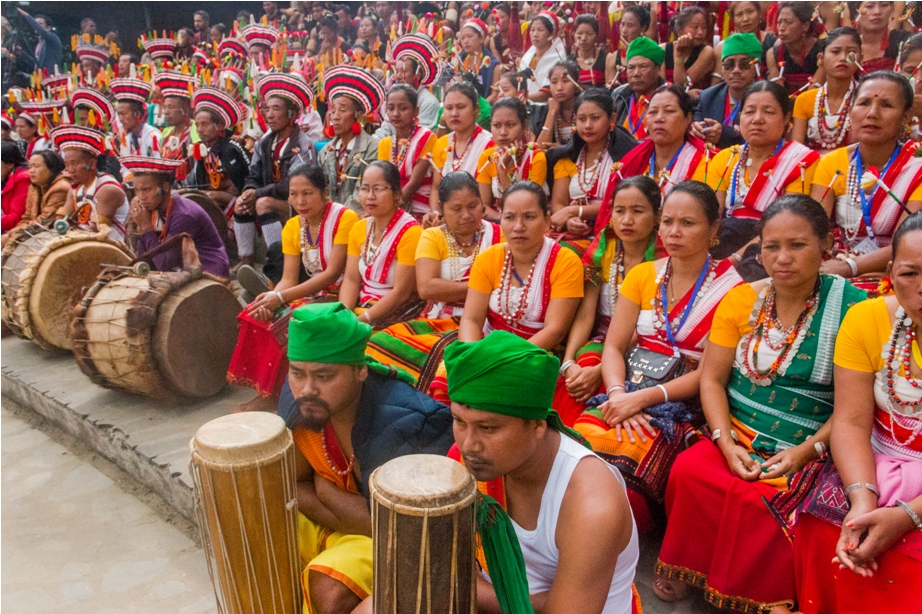
You will be sitting with these tribes and more at Hornbill festival, Kisama. Near Kohima, Nagaland, India!
I liked that akin to Bas Con (that is the bench mark), the food stalls were made entirely of bamboo poles and leaves. It was impressive indeed, especially because it was the 19th anniversary of the Hornbill festival when I visited (December 2018). I was happy to see that they were able to sustain their claim of eco friendliness for 2 decades! Even the plates, spoons, straws and bowls were made up of bamboo. So much of news on the straw nuisance makes the round across the globe. They even came up with metallic straws with was met with criticism. I wonder, how no one thought about bamboo straws. The answers to world’s plastic problems lie not in New York or London, but in North East India! If only, they cared to look!
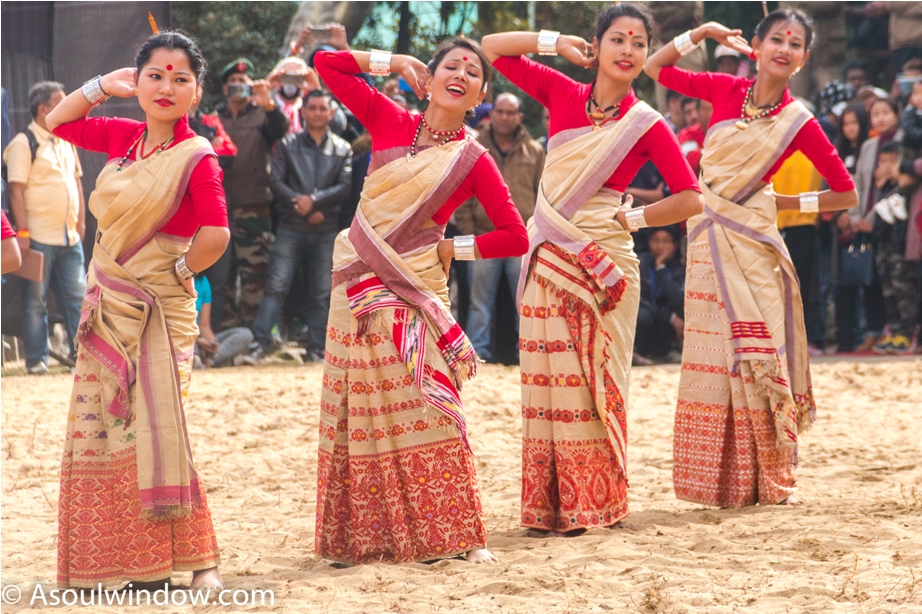
The energetic Bihu dance from Assam won our hearts! At Hornbill festival, Kisama. Near Kohima, Nagaland, India!
AN ECO FRIENDLY WASH BASIN WHICH AMUSED ME
A very quirky bamboo structure caught my attention. Turned out it was the eco-friendly wash basin for hand wash. A long bamboo pole was placed horizontally on vertical bamboo poles.
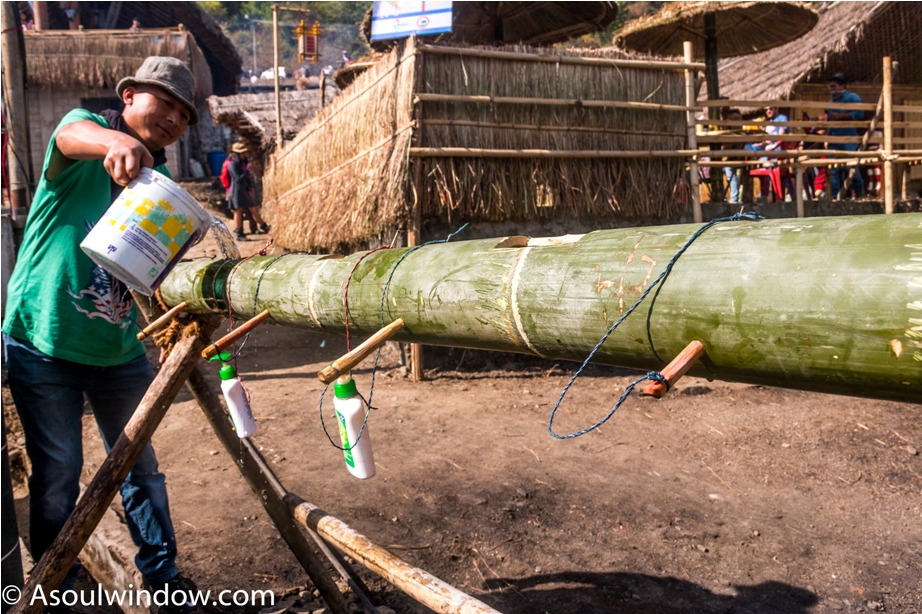
The co friendly wash basin. Only at Hornbill festival, Kisama. Near Kohima, Nagaland, India!
Small cuts were made on the horizontal pole for refilling water. Small holes were made on one side of the horizontal pole with small bamboo sticks as stoppers. So every-time, I wanted to wash my hand, I just needed to unplug the bamboo stick (which was tied to the horizontal pole) and wash! Multiple liquid soaps (in plastic though, ugh!) were also tied to the bamboo structure.
Did you understand what I am trying to say or should I write more? Maybe look at the pictures instead, if I failed as a writer!
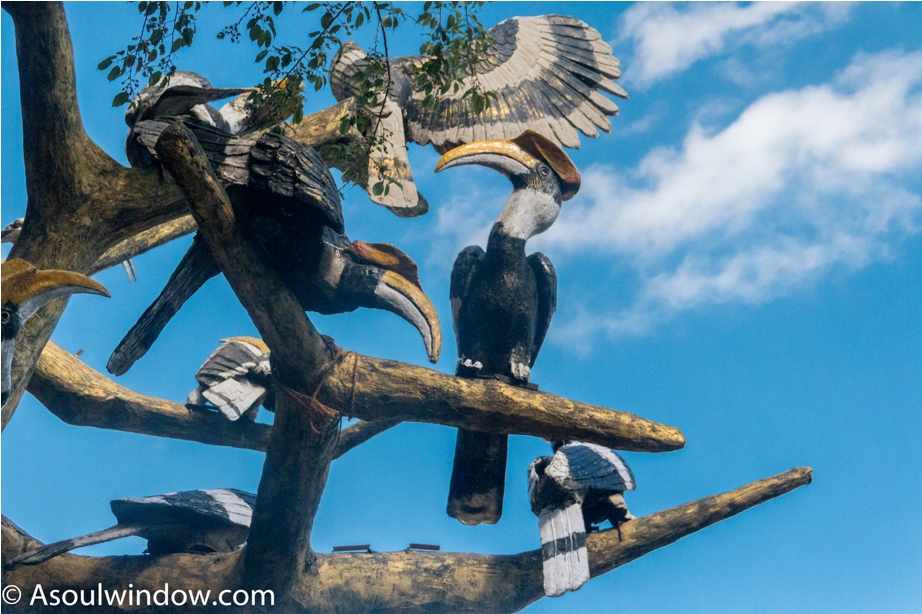
I loved this display near the festival ground. At Hornbill festival, Kisama. Near Kohima, Nagaland, India!
ECO FRIENDLY TOILET AND A DOOR MAT MADE OF BAMBOO?
A quirky door mat also made a strong statement on eco friendliness. The bamboo rings were tied to each other and made for a wonderful door mat. So, if I wanted to wipe my feet off the mat, then all I needed to do was………oh just let it be, look at the picture instead.
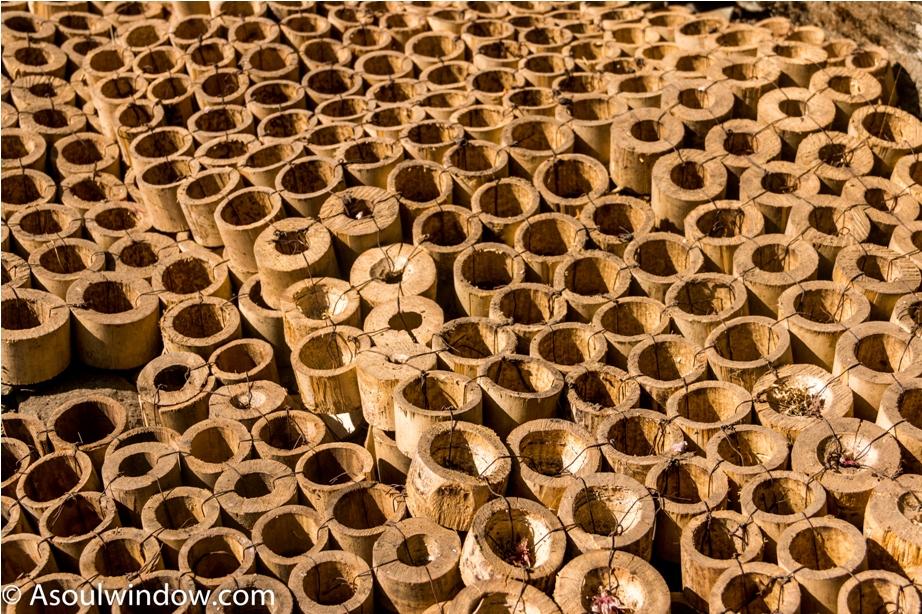
Eco friendly door-mat! Ain’t it cool? At Hornbill festival, Kisama. Near Kohima, Nagaland, India!
They even had an eco friendly toilet made entirely of leaves and bamboo poles. It was free. A paid toilet in cemented building was also available. It was priced at Rs. 10 per leak. I would rather prefer a bladder infection.
WHERE TO STAY AT DURING HORNBILL FESTIVAL, KOHIMA, NAGALAND
We stayed at a camp site organized by the very dependable Holiday Scout. They have very good knowledge on many destinations across all the states of North East India. It was a fun stay. I would wake up every morning for some silent ‘Me Time’. There was a look-out point which offered bird’s eye views of Kohima city in far distance.
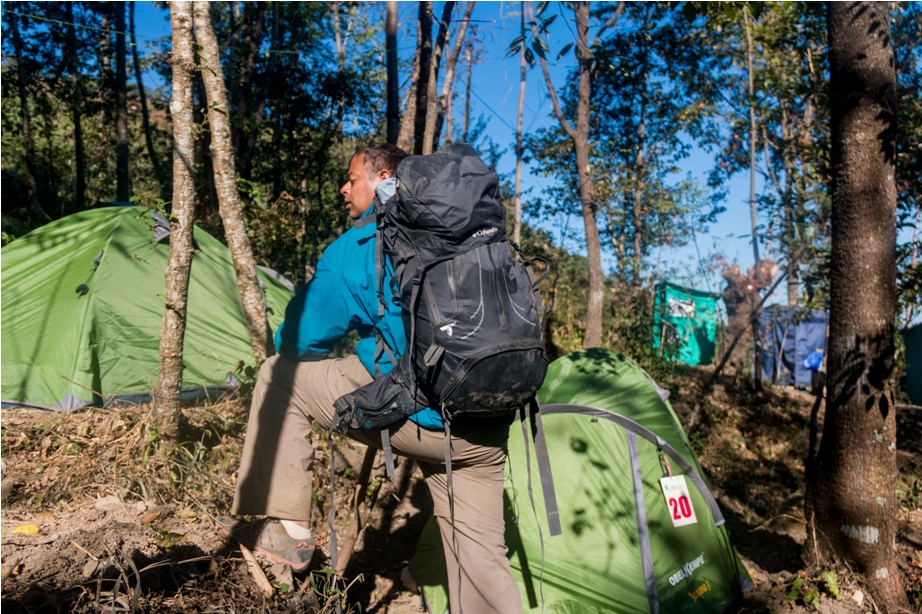
Me at my camp site.
The camps were on multi level. The toilet and bath areas (Yes, they have hot water!) were very clean and were built in stable tents with wooden floor. They served vegetarian and vegan food along-with all the other necessary evils. The sleeping bags (given by camp site) were very comforting and helped us stay warm in the December cold.
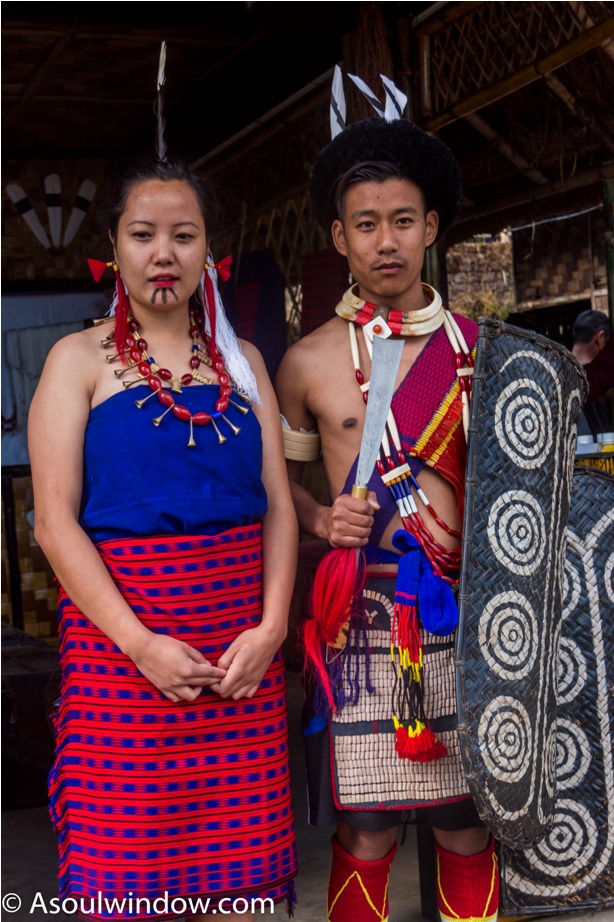
Tribals at Ao Morung. At Hornbill festival, Kisama. Near Kohima, Nagaland, India!
The best part of the camp site was the atmospheric bonfire area where I and my friends bonded over nice live guitar gigs by multi talented in house rock-star! When he was not playing, we were having a little fun with drunk people. We also met the brother of Bollywood actress and queen of Netflix, Radhika Apte (Badlapur, Parched fame). He stayed in the same camp as ours.
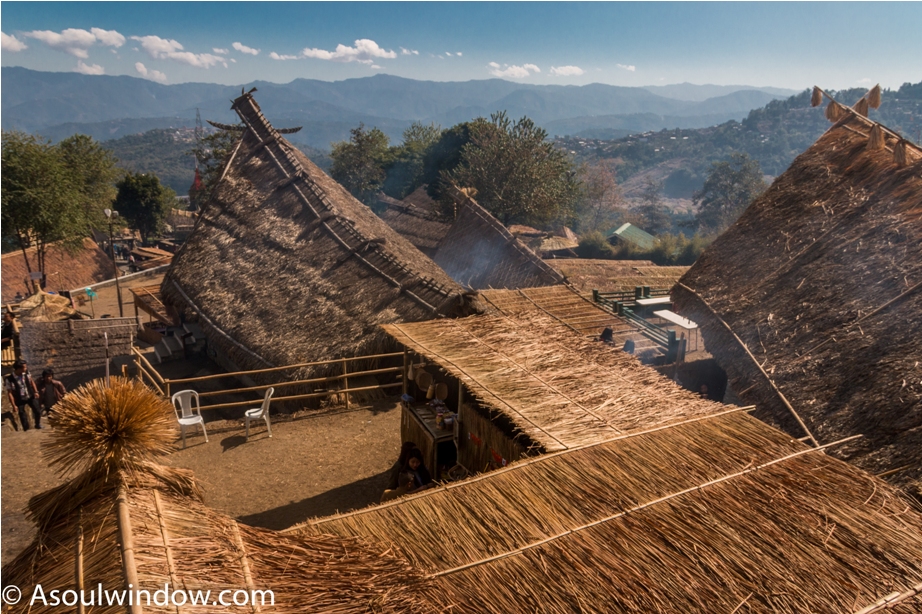
The scenic location of Hornbill festival, Kisama. Near Kohima, Nagaland, India!Have you been to any eco-friendly venue like this?
LOCATION OF HORNBILL FESTIVAL, KOHIMA, NAGALAND
Kohima is not very scenic. It is a dusty, chaotic and crowded town. I had expected Mashobara out of Kohima(Duh!)! It is instead an ordinary transit town with accessibility to many exciting destinations in Nagaland and beyond. Kisama is more peaceful and clean.
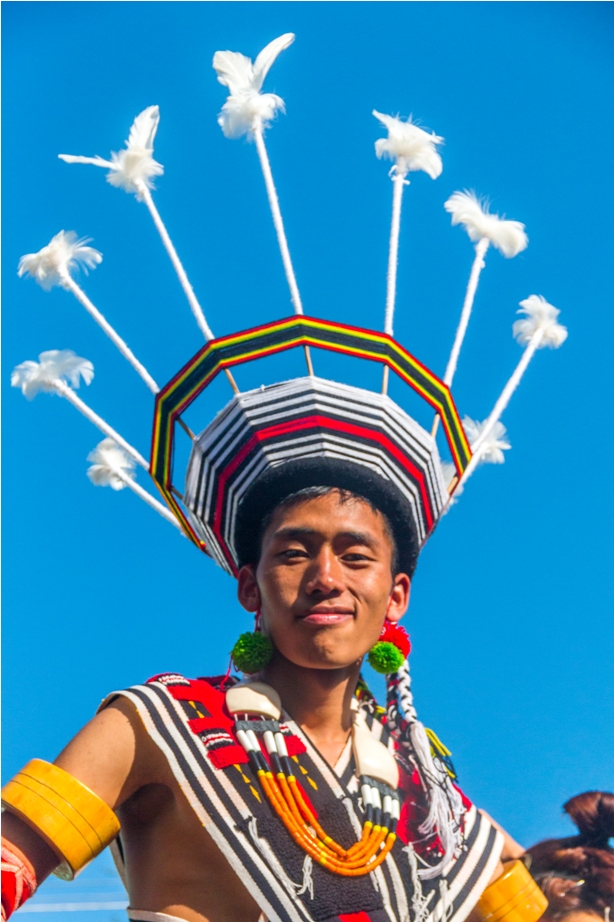
One of the tribal performances at Hornbill festival, Kisama. Near Kohima, Nagaland, India!
STAY SAFE AT HORNBILL FESTIVAL, KOHIMA, NAGALAND
Traffic Police of Nagaland is very efficient. If they spot you with even one and a half frowns, they will come running to you with genuine concern and frowns of their own, “Anything wrong? Can I help you?” “I was just looking for Gewürztraminer wine? (I said to myself). I was simply amazed at their alertness and willingness to help. Maybe Delhi police come here for a decade long training here!
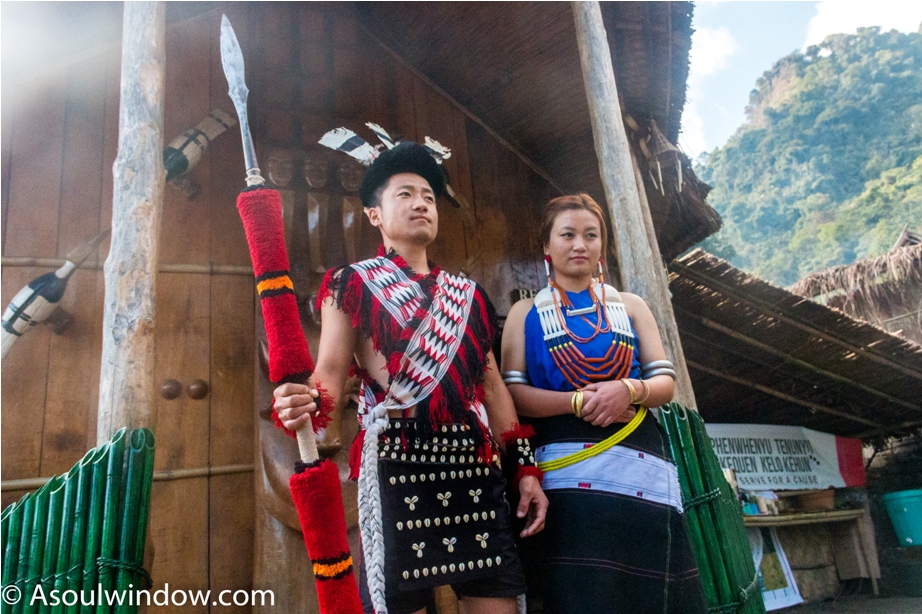
Tribal people outside Chakhesang Morung. At Hornbill festival, Kisama. Near Kohima, Nagaland, India!
My observations apart, I and my female friends found Hornbill festival, Kisama and Kohima very safe and friendly. If at all things go wrong here, like in any other destination, just approach a policeman or traffic police and DO NOT REACT OR ENTER A SCUFFLE! They don’t ‘sell’ bravery awards at the shopping area here. There are many police men across the festival venue. Be wise!
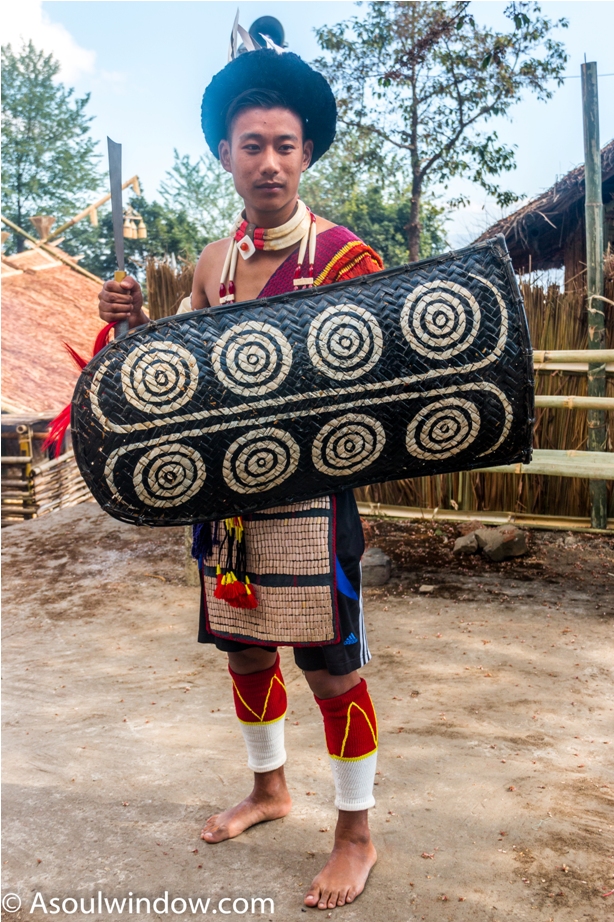
Warrior at Ao Morung. At Hornbill festival, Kisama. Near Kohima, Nagaland, India!
EXCITING THINGS TO DO IN AND AROUND HORNBILL FESTIVAL, KOHIMA, NAGALAND
Explore the Church and World War Museum near the festival grounds.
Visit Kohima Museum
Explore Kohima city, especially the poignant War Cemetery and the Churches. (There is not much to see in Kohima.
Explore nearby villages such as Vishvema and Khonoma.
Visit Dimapur Ao Baptist Church. It is the largest church in Asia.
Understand Angami lifestyle at Bara Basti
Spend 2 days at Dzukou Valley trek. The trek can be completed in 1 day, but I suggest you come back the next day. The sunset is not to be missed.
Explore the heritage of Dimapur.
Head out to Imphal (5-6 hrs) and Loktak lake in Manipur
Visit other places in Nagaland such as MonTown and (far away and bumpy roads, for both) Visit Touphema Tourist Village, 41 kilometers away from Kohima.
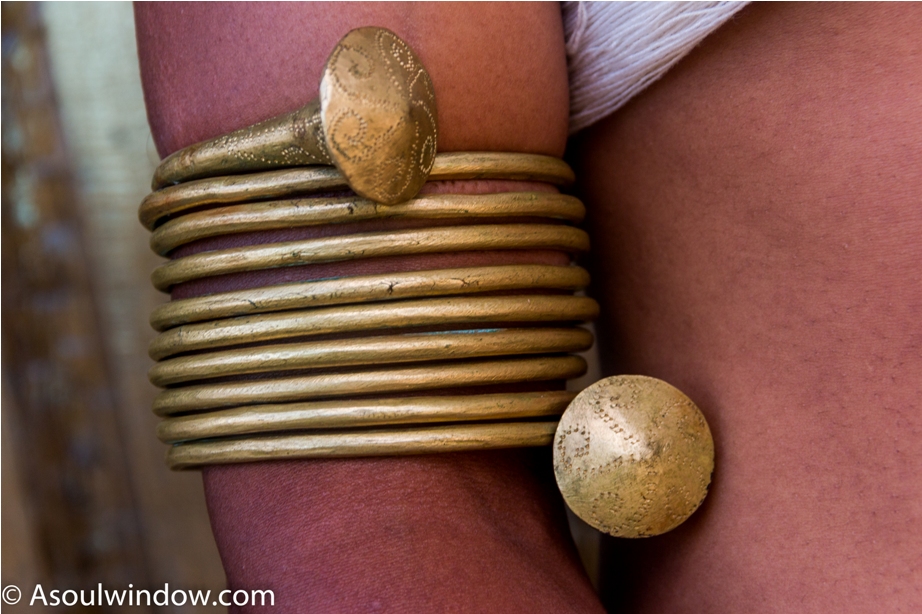
A man at Zeliang Morung. At Hornbill festival, Kisama. Near Kohima, Nagaland, India!
HOW TO REACH HORNBILL FESTIVAL, KISAMA NEAR KOHIMA, NAGALAND
I started on a bus (Rs. 150) at 10:35 am from Jorhat and reached Kohima via Dimapur at 9:30 p.m. I had to leave the bus at Dimapur. It was 4 or 5 p.m. The taxi drivers tried to fool me by telling me that no more taxis will ply on this route now. I was also told that even if I find one it will cost me Rs. 500 one way. Regular Sumo rate from Dimapur to Kohima is INR 300. I persuaded him to carry me in the same Sumo for INR 300. The bus didn’t make any stop for lunch, so eat properly before you leave.
I had a very nice unlimited Vegetarian Thali for Rs. 50 in Jorhat. (See picture for details of place. I also got my bus tickets from this restaurant. It is near a crossroad and very close to ISBT, Jorhat. Do not miss the early morning bus from Jorhat. It might get difficult to find another public transport. The closest railway station from Hornbill festival is at Dimapur from where you can take a shared Sumo opposite Dimapur railway station.
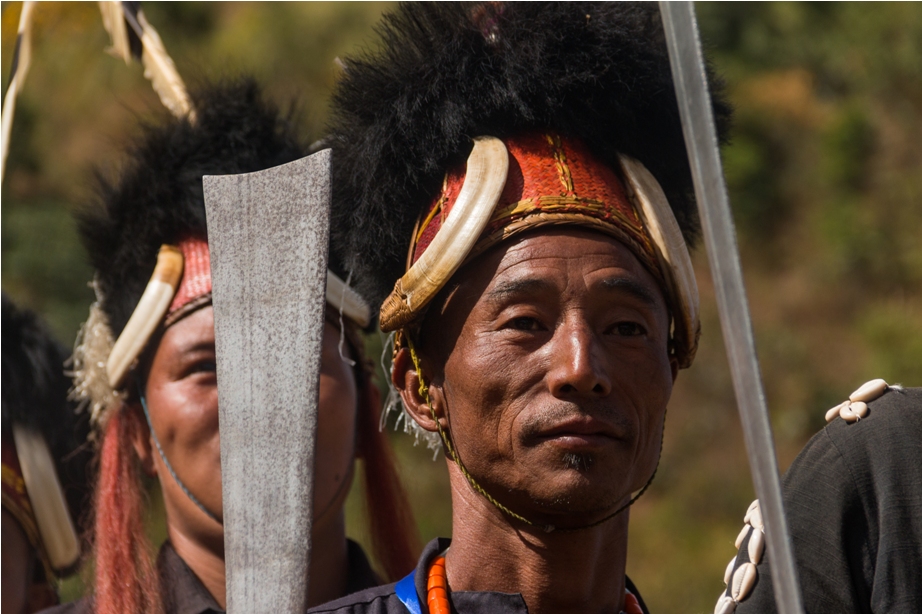
Hang out with the locals at Hornbill festival, Kisama. Near Kohima, Nagaland, India!
BEST TIME TO VISIT HORNBILL FESTIVAL, KOHIMA, NAGALAND
Hornbill festival happens every year, usually from 1st to 10th December. 1-3 days are sufficient to enjoy the festival.
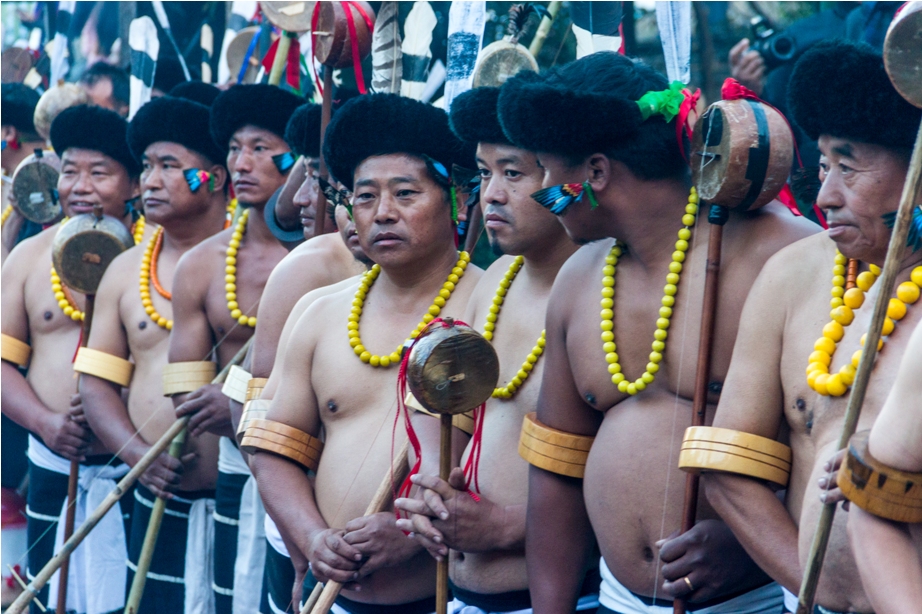
Gearing up for their performance. At Hornbill festival, Kisama. Near Kohima, Nagaland, India!
HOW TO GET INNER LINE PERMIT FOR HORNBILL FESTIVAL, KOHIMA, NAGALAND
Just before the hills started (Dimapur to Kohima route), our Sumo was stopped by the police. We were asked to show our ILPs aka Inner Line Permits. If you have traveled to Ladakh in North India, you will know what Inner Line Permit is. Both Indians and foreigners need Inner Line Permit for access to some areas in Nagaland and Arunachal Pradesh. I did not have the hard copy of the Inner Line Permit.
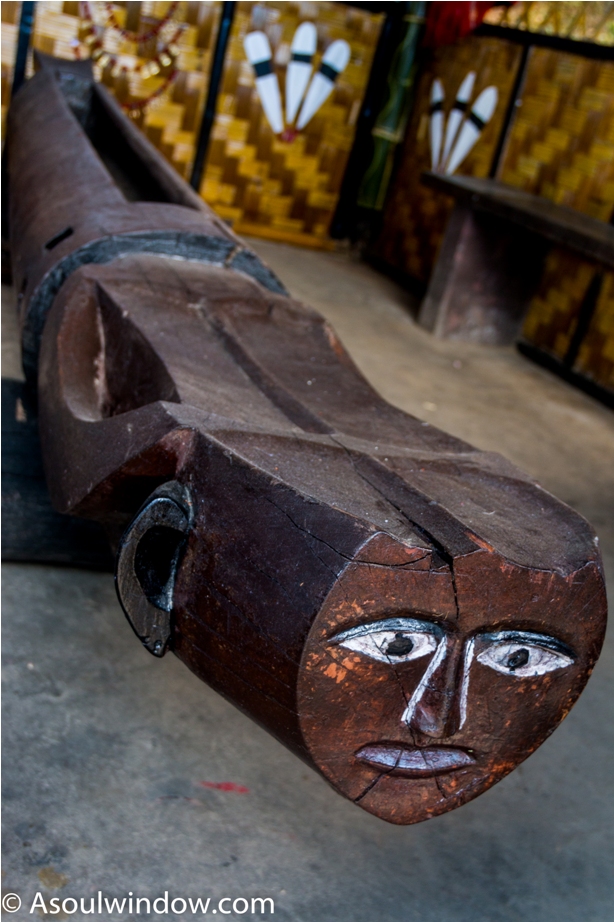
At one of the Morungs. At Hornbill festival, Kisama. Near Kohima, Nagaland, India!
I showed them the soft copy of my Inner Line Permit arranged by the very dependable Holiday Scout even before I arrived in Nagaland. They still asked me to come till their station near the main gate with signboard, “Welcome to the Hills!” We were asked to sign and fill our details in a register. They had also requested me to show them my Aadhar Card. If you are an Indian traveler, always carry Aadhar card. If you are a foreigner traveling in North East India, keep your passport handy at all times.
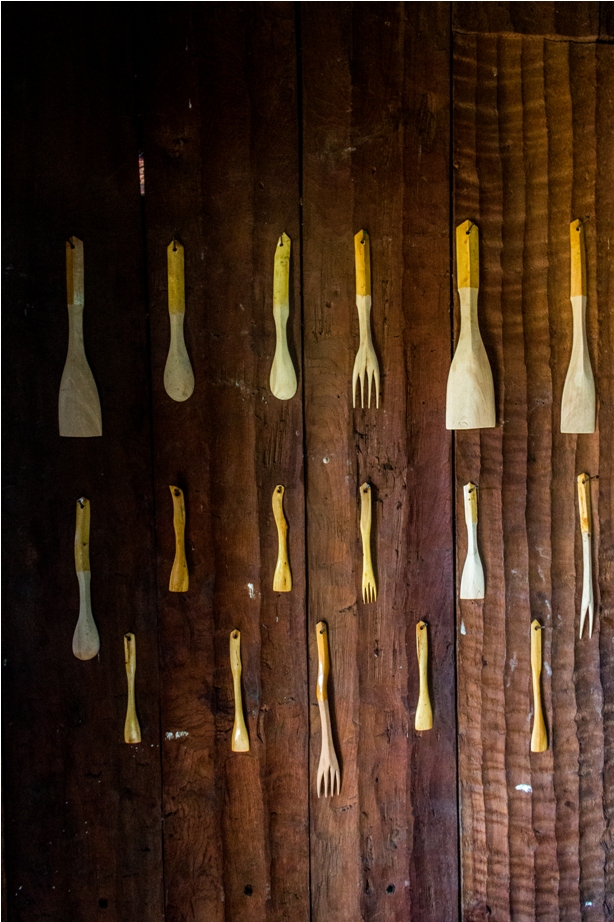
Every thing is default eco friendly in North East India. Including the cutleries made of bamboo. At Angami Morung, Hornbill festival, Kisama. Near Kohima, Nagaland, India!
Though you can get your Inner Line Permit done at both Kohima and Dimapur, I suggest that you reach early in Dimapur and stay there for 1 day to get the Inner Line Permit . It takes only few minutes but it is possible that you might reach Dimapur late and their office is closed by then. Alternatively, you can book your trip with Holiday Scout which is a reliable travel agent who can take care of your Inner Line Permit even before you arrive, thus saving you from hassles and time waste. Holiday Scout has trips where they include many exciting and remote destinations tailored around the Hornbill festival. Check this quora discussion for more information about ILP.
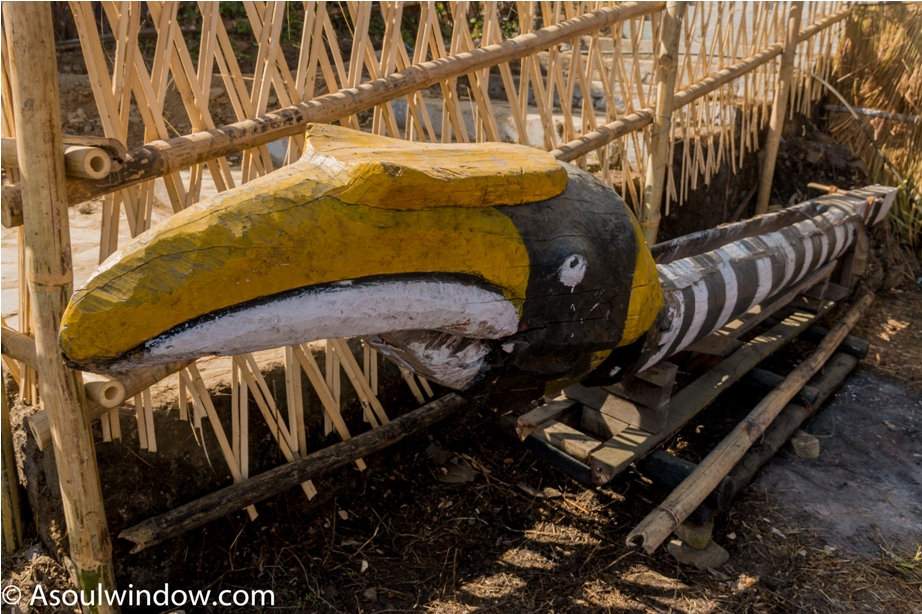
Phom Morung. At Hornbill festival, Kisama. Near Kohima, Nagaland, India!
VISIT HORNBILL FESTIVAL, KOHIMA, NAGALAND WITH YOUR FRIENDS AND WHEN YOU ARE YOUNG!
Michelle and Nikki, whose blog Cheeky Passport is a lot of fun were already in North East India when we visited. We had been planning to meet since long on whatsapp and Facebook. We finally met at the hornbill festival. You should follow them on blog and social media for informative and fun updates.
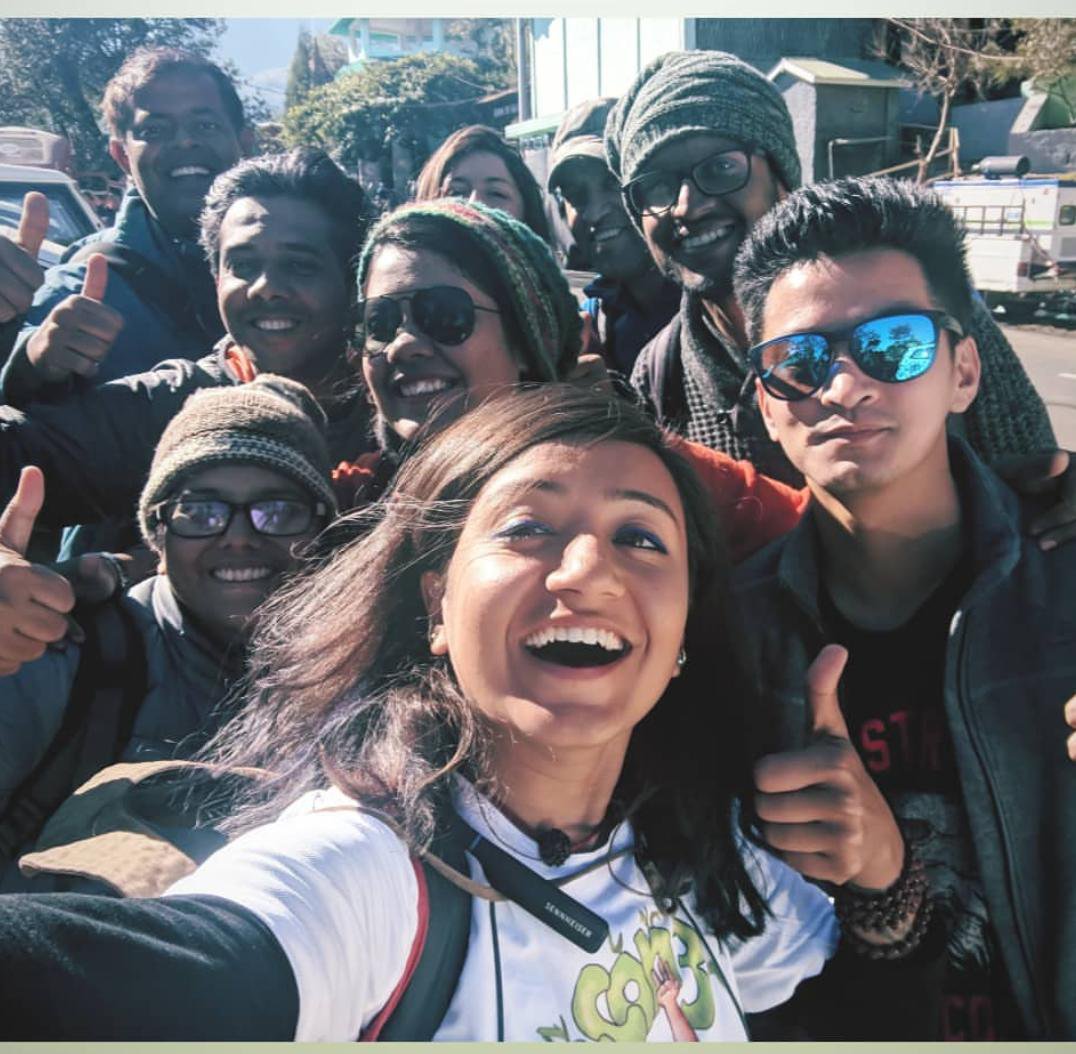
Left to right – Me, Jo, Amit, Chetan, Parnashree, Niranjan, Sandeepa, Prakriti, Sange from Holiday Scout. We had too much fun at Hornbill festival, Kisama. Near Kohima, Nagaland, India! Picture by Prakriti.
I also met Amit Chandna from Delhi. He was a stranger but we bonded so well that we ended up traveling across Manipur for 10 more days. I had planned this itinerary solo. I love solo traveling, but I love it if I have a fun and laidback company. My blogger friends had also accompanied me.
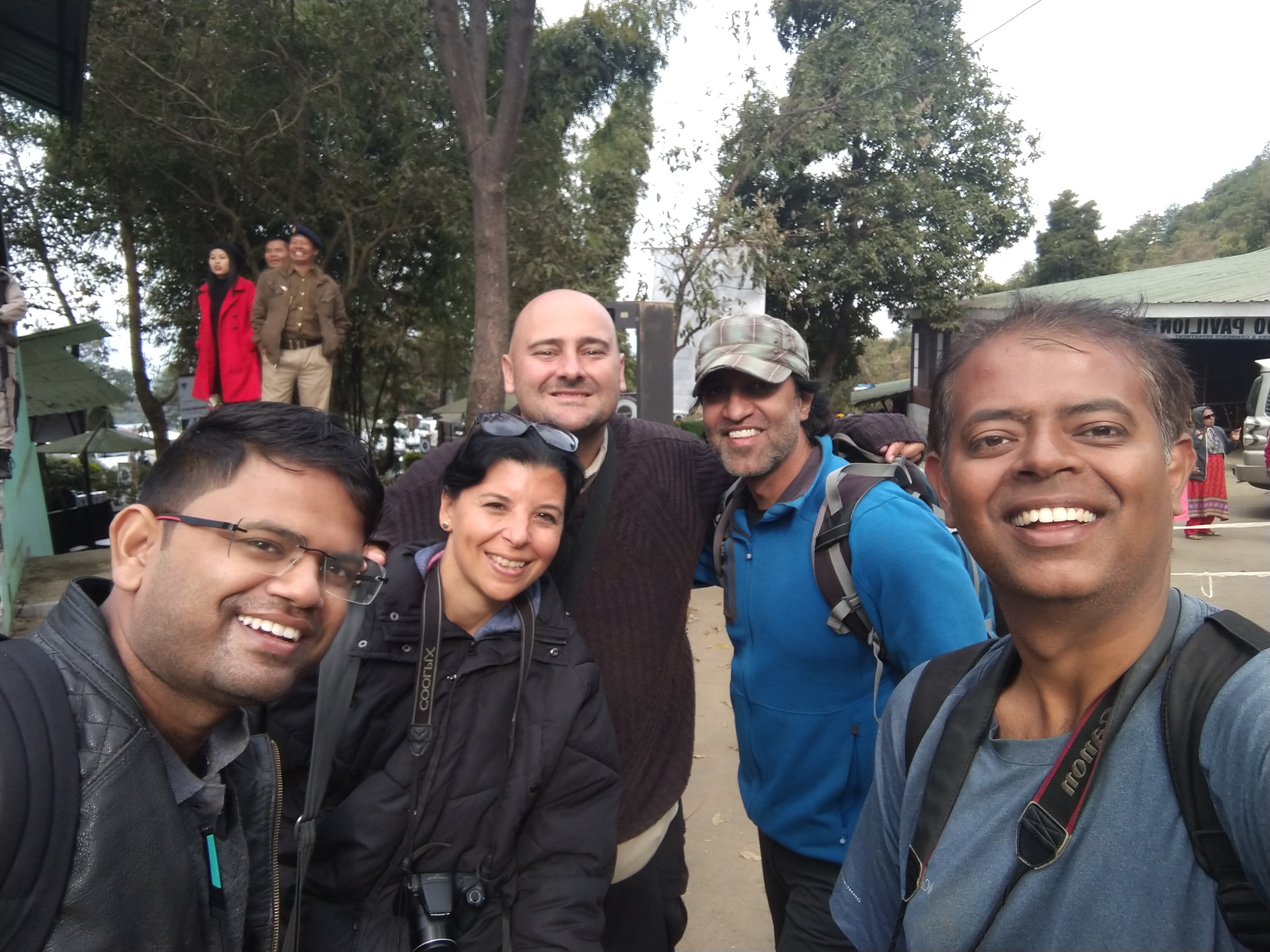
Left to right – A reader of Cheeky Passports, Michelle, Nikki, Amit and Me.
Niranjan, Parnashree, Sandeepa Chetan, Prakriti, Srikanth gave me fun company. We had already bonded like one big joint family in Basar, Arunachal Pradesh. We had unimaginable fun at Hornbill too. Having so much fun should be banned. Festivals like Hornbill should be enjoyed with family, friends and close friends. Solo travel is fine but you will love it if you could share a joke, watch a dance together or discover aaloo ka paratha at one of the stalls. Life is beautiful if you can find a fun company! Avoid people with emotional baggage though.
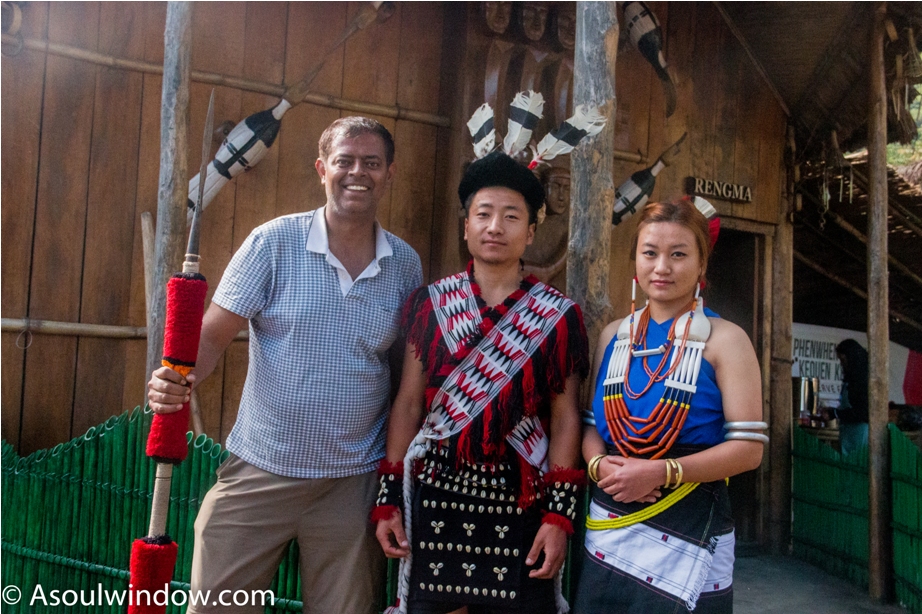
Me outside Chakhesang Morung. At Hornbill festival, Kisama. Near Kohima, Nagaland, India! Pic by: Parnashree Devi
The views from my #SoulWindow are VYING FOR MY ATTENTION!
Vegetarian and Vegan food guide at Hornbill Festival, Kohima, Nagaland
Since this is the biggest blog on Hornbill Festival on the internet, I thought, I will include a section on the vegetarian and vegan food in Hornbill Festival and Kisama/Kohima in general. So many of my vegan and vegetarian friends have asked me if it is easy to go meat-free in Nagaland. Let me break the myths in this blog.
Contrary to popular belief, Hornbill festival at Kohima has more vegetarian and vegan food than you would have thought. There is a café area near the houses, where they had a vegan café (which sold vegetarian food and eggs as well but no meat.) The lady at the vegan café also sold Aaloo Ka Parathas (mashed potatoes stuffed in wheat bread, slow roasted on griddle) at Rs. 50 per piece. Thanks to the difficulty in finding my comfort food, I binge ate 5 aaloo ka parathas on day 1. The demand of parathas was huge.
In fact, this outlet sold the most food. Vegans are a minority, says who? On day 1, I queued up for an hour to grab one paratha. The price for one paratha skyrocketed at Rs. 80 per piece and the quantity of potato filling decreased. We took our sweet revenge by emptying her fruit basket (oranges, guavas) for free as we warmed ourselves by the fire. She also sold poori chola and paratha chola (Passable!)
Next to her outlet one stall also sold delicious French Fries (Rs. 150, good quantity) topped with spring onions, cheese and chili paste. However, beware my friend Amit Chandna from Delhi ended up eating the non-vegetarian version. Turns out, they served him French Fries topped with chopped sausages. So, always ask. Another adjacent stall sold vegetarian buffet (Paneer (Not vegan), Rajma (Kidney beans curry), Aalu Gobhi (Potato and cauliflower curry), dal (lentils), rice etc. It looked delicious and tempting but I refused to spend Rs. 400 for the feast.
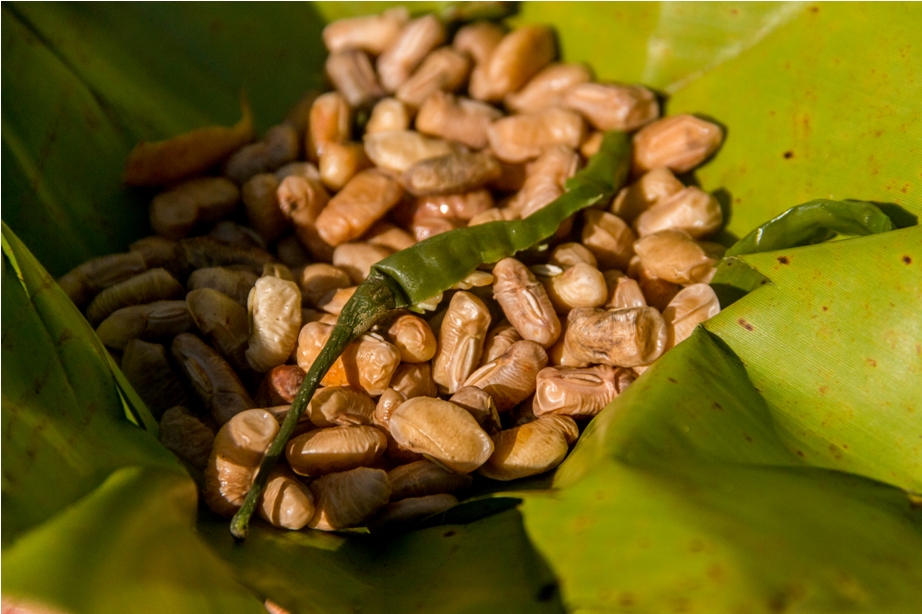
An ice cream seller from Italy had a stall near this area. I sampled their mango ice cream. It was not impressive; there was more ice than mango in it. It was priced at Rs. 60 per small scoop! At many stalls they were selling millets and other roasted grains to go with the drinks. I liked them and often snacked on them all day. It was the cheapest (and healthiest) thing available for vegans. It was sold in packets made out of fresh leaves. Local Chakhna, if you want to call it that!
I loved the millets sold at one stall (Rs. 20 per leaf potli) At Hornbill festival, Kisama. Near Kohima, Nagaland, India!
Cheaper and better options were available near the main festival area. We just discovered it on the last day! My new friend, the young and vivacious blogger/Instagrammer Prakriti helped me and Amit (who is a flexible vegetarian, meh!) find vegan paradises. She took us to the food court near the horticulture (There is nothing like ‘Hottie culture’, eh!) area for better and reasonably priced dining options. We were spoiled for choices for vegans and vegetarians here. Some of the tempting dishes for vegans were Hakka Noodles, Poori Chola (Rs. 60 for 2 big pooris and chola), pastries, cakes (might contain eggs, ask!) etc.
We ate here the next day as Prakriti took us to a secret tent in the middle of nowhere. The next day, as me and Amit were enjoying 2 plates each of poori chola each from different stalls (we were famished as we had just returned from the short but gorgeous Dzuko Valley trek), the stall owner came to us and said with a smile, “Do you realise you are brunching with the warriors!” Our co-diners were warriors from the Konyak tribe of Nagaland.
By the way, do not forget to try the kiwis and pineapple slices in a bamboo stick (A throw away Rs. 10 per piece) served in one of the kitchens. Those were the sweetest pineapples I had ever tasted. The taste and aftertaste is very different from what you get in mainland (their word, not mine) India.
One of the stalls at the Konyak house also sold Yam with daal chaawal (rice and lentils). My friend Rajiv offered me (Pitha) rice paste steamed in a leaf. It was very bland for my taste but it tasted good with the very hot Naga Chili sauce. Eat it only if you can find a sauce/chutney.
In case, you are staying in Kohima (We stayed in Kisama), you will find even more exciting options for vegans and vegetarians. Think of reasonably priced aalloo ka parathas, and samosas (always cold, still nice) or the bamboo shoot fried rice, awesome carrot soups and comforting French Fries at the Fifa café (Huge quantity!) in Kohima. Kohima has lot of cafes and restaurants. Vegetarians can also easily find bakery products, cookies, wafers and namkeens.
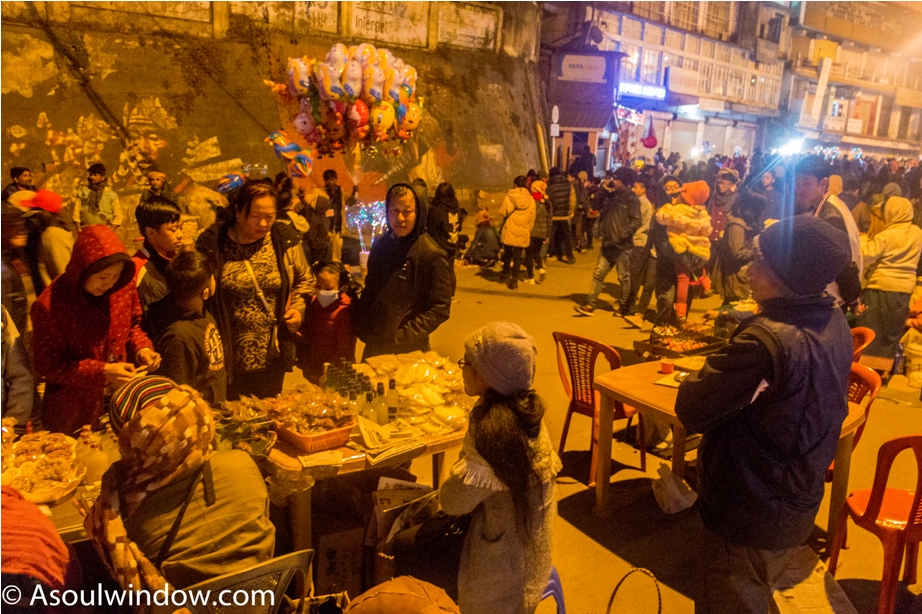
Food at night market of Kohima: Annual feature of Hornbill Festival
Every year, a night market in Kohima comes alive during the 10 days long annual Hornbill festival. I was full when we reached here, but my blogger friends Sandeepa and Chetan told me later that towards the end of the night market lot of options for vegans and vegetarians were available. Alas, I had eaten expensive aaloo ka parathas by then! We settled for tea at an al fresco stall instead, because we wanted to sit.
The very festive night market at Kohima. Do not miss it! At Hornbill festival, Kisama. Near Kohima, Nagaland, India!
As I, Amit, my blogger friends Niranjan, Parnashree and sat on one of the stalls on the streets, the bubbly anchor interviewed us about our experience of the night market and Hornbill Festival. An Italian lady Jo and her Indian husband (we were staying in the same campsite) joined us later. The only thing I sampled in the night market was a bizarre Plum wine (Obnoxious at Rs. 50 per glass).
A lady asked me to eat steamed rice cakes from her stall. I was excited to see it as I thought it was steamedIdli with piping hot sambhar and coconut chutney. Ambrosia finally! But I realized it was not. I had already eaten lot of authentic and bland vegetarian food in North East India by now. (I was on a two months long trip to North east India!)
The vibes of Night market were festive and a bit too Christmasy for my taste! In North East India, I discovered they start getting excited for Christmas more than a month before the D Day! A small park was decorated with lights, balloons, Christmas tree (meh!) and scenes from the life of Jesus! We were a month away from Christmas. Even the Europeans traveling with me freaked out at the premature excitement. “Isn’t it too early for Christmas?”, said XYZ from Netherlands who traveled with me from Jorhat to Kohima on a 12 hours long grueling journey on bus and shared Sumos!
You will find scores of street hawkers selling food, drinks, toys (so that unruly kids busy themselves and behave!), balloons (with lights), party horns with lights and other such festive products. Even if you are staying at Kisama and not Kohima (Both are just 12 kilometers but 15 light years away from each other!), I suggest that you pay a visit. Cheap thrills are made up of this!
Alcoholic and non-alcoholic beverages at Hornbill Festival, Kohima, Nagaland
During my travels across Nagaland, I tasted a variety of fascinating local drinks, both alcoholic and non-alcoholic. The most popular traditional brew is Zutho, a mildly alcoholic rice beer that’s slightly tangy, smooth, and often served during festivals like Hornbill. In some villages, I also tried Thutshe and Khe, stronger rice-based drinks traditionally brewed by the Angami and Sema tribes. For non-alcoholic options, locals offered me fruit beers and black tea infused with wild herbs, bamboo water, and ginger-lemon brews that felt refreshing in the cold weather. These beverages, made from homegrown ingredients, beautifully reflect Nagaland’s deep-rooted connection with nature and community traditions.
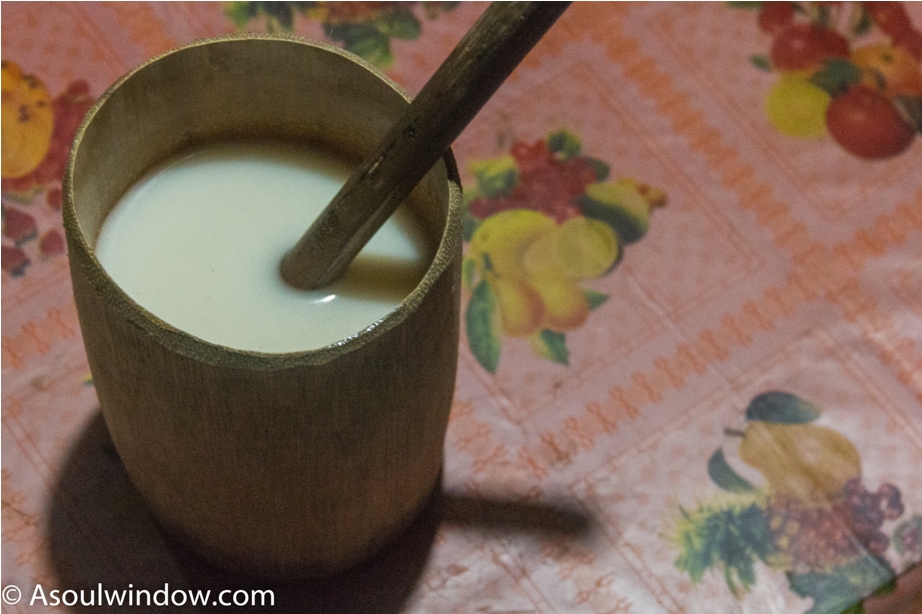
At the Hornbill festival, you can find the crappy Plum Juice at Rs. 50 per glass! (None of my friends wanted a repeat sip, “tastes too fermented, they said”!). At the festival ground, I bought a very unpleasant Corn beer from the stalls of one of the houses. My friend Rajiv liked it but I could not consume it beyond few sips. It was too bland and had a weird taste. I tried to eat corn kernels at the bottom of the mugs but could not enjoy it. I was not mixing any Naga Chilli sauce to it! I instead kept the fancy bamboo mug as souvenir. It was a non-alcoholic drink!
I tried the local rice beer. It was very different from the Poka aka Apong we had tasted during the Basar Confluence in Arunachal Pradesh. I could not enjoy it either. The taste and the dense texture of this rice beer was off putting to me. As some of my friends guzzled one mug after the another, I was looking for excuses to not order another mug. It was white as milk, too thick and tasted bizarre (Obnoxious to me, serve me the second worst drink instead!). It also leads to gas problems, I was told!
So, go slow if you still want to try it. Never mind, I, anyhow collected another bamboo mug as souvenir. But I badly missed the adorable Poka (Rice beer/wine commonly found in Arunachal Pradesh) which was not available here. All of us (10 bloggers) bonded over bottomless bamboo mugs of Poka and lost our hearts to this universally adored drink! We tasted other drinks such as Chaam and Arra (Dude, what did I just taste!) in Mechuka but nothing replaced our love for Poka!
The local rice beer neither looked good nor tasted good. At least to me. I missed the Poka aka Apong badly, the rice beer from Arunachal Pradesh. At Hornbill festival, Kisama. Near Kohima, Nagaland, India!
You can try the coffee bar near the festival grounds. They have many expensive options of coffees available. We tasted the Naga coffee (Rs. 150 per cup of cappuccino). They claimed that the coffee they were serving was grown in Nagaland. It was not worth writing home about but good enough if you get a cardiac arrest in the absence of coffee in your blood stream.
Also, you can-not find cold drinks in Kisama, so pack some cans from Kohima if (again) your life depends on it. I do not remember any other drinks I tasted in the Hornbill festival. Please comment in the comment section below for your suggestions on alcoholic/nonalcoholic drinks and vegan/vegetarian food available (or discovered) in Hornbill festival, Kisama.
The views from my #SoulWindow are worth fighting for!
Please follow the hashtag #ASoulWindow on Instagram, Twitter and Facebook for my free tips, pictures, videos and information on all things travel!
A vegan dish made with banana leaves in Nagaland
Local vegetarian and vegan food of Nagaland
I backpacked across Nagaland for a month, deeply exploring places like Khonoma, Longwa, Mon, Mokokchung, and Kohima etc, and one of my favourite parts of the journey was discovering the local vegetarian and vegan food. Though Nagaland is known for its meat-heavy cuisine, I was surprised by how many plant-based dishes I found in local homes and small eateries. I often ate boiled vegetables seasoned with bamboo shoot, fermented soybeans (akhuni), and axone chutneys that added a smoky depth to the meal.
Pumpkin leaves, mustard greens, and wild ferns were commonly cooked with chilli and salt, keeping the flavours earthy and simple. I enjoyed sticky rice, millet-based meals, and foraged herbs, often paired with spicy local chutneys. In Kohima, I tasted bamboo shoot pickle and smoked chilli sauces, while in Mon, villagers offered me freshly brewed millet beer (zutho)—a mildly tangy, vegan-friendly drink. Each meal reflected Nagaland’s deep connection to nature, sustainability, and traditional cooking methods.
During my month-long backpacking trip across Nagaland — through Longwa, Mon, Khonoma, Mokokchung, and Kohima etc— I discovered a fascinating side of Naga cuisine that caters beautifully to vegetarians and vegans if you know what to ask for. I particularly loved Yongchak Eronba, a hearty dish made with mashed Yongchak (stinky beans), potatoes, chillies, and sometimes fermented fish (Ngari), so it’s best to check before eating if you’re vegan. Yongchak has a strong, pungent aroma but an earthy, nutty taste that pairs wonderfully with galangal (locally known as pullei) — a root similar to ginger but with a more citrusy flavour, widely used in chutneys and stews across eastern Nagaland.
Nagaland Style vegan daal
In Longwa, right on the India–Myanmar border, I was served a rustic stinky beans chutney blended with broad beans, potatoes, and pullei — a unique mix that captures Nagaland’s love for foraged ingredients. The local Naga daal was unlike anything in North India — lighter, mildly spiced, and often cooked with local greens or herbs. I relished bamboo shoot chutney and the fiery Bhut Jholokia chutney, made from one of the world’s hottest chillies, measuring over 1,041,427 SHU (Scoville Heat Units).
Meals often included daal-chawal (lentil and rice) accompanied by wild vegetable curries, pickles, and fresh chutneys. One millet-based dish I found nourishing was Kholar millet porridge, a traditional staple among rural Nagas, known for its high fibre and mineral content. Do try the tiny, bitter local brinjal (titaguti), and the unique Naga tree tomato, called Sei Bangenuo in the Tenyidie dialect, meaning “tree tomato.” This tangy, egg-shaped fruit adds a refreshing twist to chutneys and salads. Avoid paneer-based dishes though — Nagaland’s charm lies in its earthy, indigenous flavours, not in paneer gravies.
Eronba. Vegan food of Nagaland
One of the most distinctive flavours I encountered while backpacking across Nagaland was the sharp, tongue-tingling Sichuan pepper, locally called ‘Meghu’ in some Naga dialects and ‘Timu’ among the Ao tribe. I tasted it in Tirap and Longding as well, where I met people of Wancho and Nocte Tribes of Arunachal Pradesh. Not many people know that headhunters are also found in the nearby Arunachal Pradesh. Do read my detailed blogs on them and their unique Oriah festival.
Unlike black pepper, it doesn’t burn but creates a pleasant numbing sensation, perfectly complementing chutneys, bamboo shoot curries, and mashed vegetable dishes like Eronba. Another remarkable local ingredient is the turmeric of Northeast India, known for its deep golden hue and high curcumin content, especially the Lakadong turmeric from Meghalaya, which contains up to 7–9% curcumin (compared to 2–3% in regular varieties). It’s prized for its strong aroma, medicinal value, and natural purity. Also keep your eyes peeled for fresh kiwi, pineapples, apples and oranges here. The tastiest and juiciest fruits I have ever had was in North East India and Shymkentin Kazakhstan in Central Asia.
Frequently Asked Questions
Hornbill festival is celebrated in which state of India?
The Hornbill Festival is celebrated in the state of Nagaland, located in Northeast India. Held every year from 1st to 10th December in the Kisama Heritage Village near Kohima, the festival showcases the rich cultural heritage of Nagaland’s 17 major tribes. Named after the Great Indian Hornbill bird, a revered symbol in Naga folklore, the festival brings together traditional dances, folk songs, indigenous games, crafts, and cuisines under one vibrant celebration. Often called the “Festival of Festivals,” it was first organized by the Government of Nagaland in 2000 to promote inter-tribal harmony, preserve local traditions, and attract tourism to the region.
Is hornbill the state bird of Nagaland?
Yes, the Great Indian Hornbill (Buceros bicornis) is the state bird of Nagaland. Revered in Naga folklore and traditional art, it symbolizes strength, grandeur, and the deep bond between humans and nature. Hornbill feathers were once used to adorn tribal headgear as a mark of valor and status. Nagaland’s rich forests are home to several hornbill species, including the Great Indian Hornbill, Rufous-necked Hornbill, Wreathed Hornbill, Oriental Pied Hornbill, and Austen’s Brown Hornbill. These magnificent birds play a vital ecological role as seed dispersers. Conservation efforts are ongoing to protect them from habitat loss and traditional hunting pressures.
Which is the state bird of Arunachal Pradesh?
The Great Hornbill (Buceros bicornis) is the state bird of Arunachal Pradesh, celebrated for its striking casque and vibrant plumage. Revered in local folklore, it symbolizes strength, protection, and the rich biodiversity of the region. Arunachal Pradesh, with its dense forests and hilly terrain, is home to several hornbill species, including the Great Hornbill, Rufous-necked Hornbill, Wreathed Hornbill, Oriental Pied Hornbill, Racket-tailed Hornbill, and Brown Hornbill. These birds play a crucial ecological role as seed dispersers in the forest ecosystem. Conservation efforts are being prioritized to safeguard their habitats and reduce threats from hunting and deforestation.
What is another name for Hornbill Festival?
Another name for the Hornbill Festival is often “Festival of Festivals.” This nickname highlights how the event brings together all the major Naga tribes of Nagaland to celebrate their unique cultures, dances, music, food, and traditions in one grand showcase.
Who is the founder of Hornbill Festival?
Who started the Hornbill Festival? The Hornbill Festival of Nagaland was initiated and founded by the Government of Nagaland, with a strong vision to preserve, showcase, and promote the rich cultural heritage of the Naga tribes. It was first organized in the year 2000 under the leadership of then Chief Minister S.C. Jamir. The idea was to create a platform that would unite the 17 major Naga tribes, highlight traditional music, dance, crafts, and cuisines, and attract tourism to the state. Over the years, the festival has grown into a grand cultural extravaganza, earning the nickname “Festival of Festivals” in Northeast India.
Rare Great Hornbill
When did first Hornbill Festival Start?
The first Hornbill Festival was held in December 2000 in Kisama Heritage Village, near Kohima, Nagaland. It was organized by the Government of Nagaland under the leadership of then Chief Minister S.C. Jamir with the aim of promoting and preserving the rich cultural heritage of Nagaland’s 17 major tribes. The festival was designed to showcase traditional music, dance, crafts, sports, and cuisines while also attracting tourism to the state. Over the years, it has grown into a ten-day cultural extravaganza celebrated every December, earning the nickname “Festival of Festivals” and becoming a major event in Northeast India’s tourism calendar.
What makes Hornbill festival so famous across the world?
The Hornbill Festival in Nagaland became one of the most unforgettable experiences of my travels because it’s so much more than a festival—it’s a vibrant celebration of life, culture, and community. Held every December in Kisama Heritage Village near Kohima, it brings together all 17 major Naga tribes under one roof, each showcasing their distinct traditional dances, music, costumes, and rituals. What fascinated me the most was the energy and pride of the performers—warriors in traditional attire, women in colourful handwoven dresses, and musicians playing indigenous instruments—it felt like stepping into a living, breathing history.
The festival is also a haven for food lovers like me. From stinky beans chutney and bamboo shoot dishes to millet-based porridges and traditional rice beer (Zutho), the local cuisine offers a unique taste of Naga culture. I especially loved the night market, where artisans sold handwoven shawls, wood carvings, and jewellery, and every corner offered a story about the tribe behind it. Another reason Hornbill Festival is so famous is the sheer scale of its events—from traditional games and archery to contemporary rock concerts and food competitions. Experiencing it firsthand, I realized it’s a perfect blend of tradition and modernity, and it truly captures the soul of Nagaland, making it unforgettable for anyone who visits.
What are the other festivals of Nagaland apart from the Hornbill Festival?
Apart from the Hornbill Festival, Nagaland is home to a rich variety of local tribal festivals that you can experience if you travel across the state. Each tribe has its own unique celebration, often linked to agriculture, harvest, or traditional customs. For example, if you visit Mon district, you can witness the Moatsu Festival of the Ao tribe, held in May, which marks the sowing season and features traditional dances, music, and feasts. In Tuensang, the Chang tribe celebrates Monyu Festival around July–August, a vibrant event to honor the harvest and strengthen community bonds.
The Sekrenyi Festival of the Angami tribe, celebrated in February, is a purification festival where you can see traditional rituals, dances, and songs that cleanse both the mind and the village. The Tokhu Emong Festival of the Lotha tribe in November marks the end of the harvest season and is full of singing, dancing, and sharing of local food. The Naga New Year Festival in some districts brings together tribes to celebrate with sports, cultural shows, and handicraft fairs. When you travel in Nagaland, attending these festivals gives you a deeper understanding of tribal identity, agricultural traditions, and the strong sense of community that defines the state, beyond what the Hornbill Festival alone can show.
What is the purpose of the Hornbill Festival?
The Hornbill Festival was created with a clear purpose: to preserve, celebrate, and promote the unique cultural heritage of Nagaland. Unlike other festivals, it is not just about entertainment—it is a deliberate effort to bring together all 17 major Naga tribes in one place, creating a platform for inter-tribal interaction and cultural exchange. When you attend, you quickly realize that it’s designed to strengthen community identity, allowing younger generations to learn about traditional dances, music, crafts, and folklore that might otherwise fade away.
Another key purpose is tourism promotion. Nagaland is rich in natural beauty, traditional crafts, and indigenous lifestyles, but these were largely unknown outside the region. The festival provides an opportunity for both domestic and international tourists to engage directly with tribal life, taste authentic cuisines, purchase handwoven textiles, and experience rituals and performances firsthand.
The festival also supports local artisans and performers, giving them a platform to showcase their skills and generate income through crafts, food, and cultural demonstrations. Additionally, it fosters environmental awareness, as many performances and displays highlight the Naga tribes’ deep connection to forests, wildlife, and sustainable farming practices. In essence, the Hornbill Festival serves as a bridge between tradition and modernity, culture and commerce, community and the world.
What makes the Konyak tribe so popular in the Hornbill Festival?
For me and several other global travellers in Nagaland, the Konyak tribe stood out as one of the most fascinating at the Hornbill Festival, and it’s easy to see why they are so popular. Known historically as fierce warriors, the Konyaks carry a strong sense of identity that’s reflected in their art, attire, and rituals. At the festival, their elaborate traditional costumes, adorned with beads, feathers, and intricate headgear, immediately catch your eye. Many of the elders wear tattoos on their faces and arms, a mark of bravery and past warrior achievements, which makes their presence both striking and memorable.
I was particularly drawn to their handcrafted woodwork and iron tools, which they proudly display at the stalls. Their storytelling sessions about tribal history, folklore, and traditions are incredibly engaging—you feel like you are stepping into their ancestral past. The Konyak also perform energetic war dances, often accompanied by drums and traditional songs, which are mesmerizing to watch.
Food of Konyak Tribe is another highlight; they serve unique local dishes like smoked vegetables and rice beer, giving a taste of their heritage. What impressed me most was the pride and openness with which they share their culture, making visitors feel welcome. For me, the Konyak tribe embodies the raw, authentic spirit of Nagaland, and seeing them at Hornbill Festival was unforgettable.
What should I wear to the Hornbill Festival?
What to wear in Hornbill Festival? When I attended the Hornbill Festival in December, dressing comfortably and smartly was key, especially because the weather can be quite chilly in the evenings. During the day, I wore t-shirts and light trousers, which were perfect for exploring the festival grounds, watching performances, and wandering through the night market. By evening, temperatures dropped, so I needed jackets and warm layers to stay comfortable while enjoying the cultural shows and outdoor events.
For female travellers, short or revealing dresses are generally allowed, but I noticed it’s best to layer with a jacket or shawl at night, as it can get cold quickly. For everyone, comfortable shoes are a must; you’ll be walking a lot on uneven paths, so slippers or heels are not practical. I opted for sturdy sneakers, which made long days of walking and standing at performances much easier. I also found that light scarves, gloves, and hats helped a lot in the evening. Daytime is sunny and pleasant, but the cold sets in once the sun goes down. Overall, dressing in layers, wearing comfortable shoes, and carrying a warm jacket made my experience at Hornbill Festival enjoyable and hassle-free. That said, it was nowhere as cold as I felt in the remote Mechuka and Dorjeeling village (Not Darjeeling) of Arunachal Pradesh.
What is the story behind Hornbill Festival?
The Hornbill Festival was born out of a desire to weave together the vibrant diversity of Nagaland’s tribes. Each tribe—Angami, Ao, Sumi, Konyak, Lotha, and many more—brings its own dance, song, and story, like threads of colour in a living quilt. The festival celebrates the valor of warriors, the artistry of craftsmen, the wisdom of elders, and the joy of communities united. Named after the majestic Hornbill, a symbol of courage and cultural pride, it’s a time when the hills echo with drums, horns, and laughter, and the spirit of each tribe shines through, creating a heartbeat that belongs to all of Nagaland.
What is the biggest festival in northeast India?
The Hornbill Festival in Nagaland is widely regarded as the biggest festival in Northeast India, bringing together all 17 Naga tribes in a spectacular celebration of culture, music, dance, and cuisine. But the region is rich in festivals across its seven states. In Assam, the vibrant Bihu and the colourful Raas festival in Majulishowcase traditional Vaishnavite music, dance, and riverine rituals.
In Arunachal Pradesh, festivals like Losar and Ziro Festival of Music, which I had the pleasure of attending, celebrate local tribes and contemporary art. Meghalaya hosts Wangalafestival, the drum festival of the Garos, while Mizoram’sChapchar Kut marks spring with folk dances. Manipur’sYaoshang and Sangai Festival highlight sports, culture, and indigenous traditions. Tripura’s Garia Puja and Kharchi Puja reflect agricultural and spiritual heritage, and in Sikkim, the Losoong festival celebrates the harvest with Cham dances. I also experienced the Basar Confluence Festival in Arunachal Pradesh, which brought together tribes from different valleys, mainly my favorite, the friendly Galo People. Each festival, in its unique way, reflects the deep-rooted traditions, community spirit, and natural beauty of Northeast India.
Which is the nearest airport to Hornbill Festival?
The nearest airport to the Hornbill Festival, held at Kisama Heritage Village near Kohima, is the Dimapur Airport (DMU) in Nagaland, located about 70 kilometres from the festival venue. It’s the only civil airport in the state, well-connected to Guwahati and Kolkata by regular flights.
When I attended the festival, I arrived via Guwahati Airport (GAU), the largest in Northeast India, and then took a scenic drive of around 7–8 hours to Kohima. Another alternative is Imphal Airport (Tulihal Airport) in Manipur, about 145 kilometres away, which offers broader connectivity for travellers coming from other parts of India.
In which month Hornbill Festival is held every year?
The Hornbill Festival is held every year in the month of December, from 1st to 10th, at Kisama Heritage Village near Kohima, Nagaland. December in Nagaland is pure magic—crisp mountain air, misty mornings, and golden sunsets over pine-covered hills. I loved the cold winter weather, which added a cozy charm to the entire experience. Unlike the humid plains, there was no sweat, no discomfort, just fresh, clean air and the scent of woodsmoke everywhere.
Each evening after the festival performances, my friends and I would gather around a bonfire, sipping local tea and chatting under a sky full of stars. The chill made even simple meals feel comforting—I especially enjoyed the hot, spicy vegetarian food made with bamboo shoots, lentils, and local greens. December in Nagaland felt like stepping into a world where time slowed down, laughter grew warmer, and every night ended in stories and song.
What language is spoken in Nagaland? What Script is used in Nagaland?
Nagaland is a land of incredible linguistic diversity, with more than 16 major tribes and several sub-tribes, each having its own distinct language and dialect. Some of the widely spoken tribal languages include Ao, Angami, Sumi, Konyak, Lotha, and Chakhesang. However, since these languages are often mutually unintelligible, Nagamese, a creole based on Assamese, Hindi, and local dialects, has emerged as the common lingua franca across the state. Many Nagas can also speak and understand good Hindi.
Do they speak English in Nagaland?
Interestingly, the official language of Nagaland is English, and it’s widely spoken, especially among the younger generation, in schools, markets, and government offices. As a traveller, I found it very easy to communicate in English throughout the state. Most written communication, education, and media use the Roman script, even for many local languages that have been transcribed into it. This blend of linguistic diversity and English fluency makes Nagaland a culturally rich yet accessible destination for visitors.
How to reach Hornbill Festival from Guwahati?
Reaching the Hornbill Festival from Guwahati is quite convenient, with multiple travel options available. The nearest airport is Dimapur Airport (DMU), which has daily flights from Guwahati and Kolkata. From Dimapur, you can hire a taxi or take a shared cab to Kohima, about 70 km away, which takes around 2–3 hours by road.
If you prefer the train, there are regular services from Guwahati Railway Station to Dimapur Railway Station, and from there, local taxis and buses can take you to the Kisama Heritage Village, where the festival is held. Budget travellers can also take interstate buses operated by the Nagaland State Transport (NST) or private operators from Guwahati to Kohima, a scenic journey of 7–8 hours through rolling hills and lush forests. I personally enjoyed the road trip in a bus from Dimapur—it offered incredible views and the thrill of entering Nagaland’s cultural heartland.
What is the name of the airport in Nagaland?
The only airport in Nagaland is the Dimapur Airport (DMU), located about 70 kilometres from Kohima, the state capital. It serves as the main air gateway to Nagaland and nearby regions of Assam and Manipur. The airport operates regular flights to Guwahati and Kolkata, connecting Nagaland to the rest of India. Situated in Dimapur city, it’s surrounded by scenic hills, lush greenery, and traditional Naga villages, making even the short drive from the airport a picturesque experience. Dimapur itself is a bustling commercial hub, offering a mix of urban life and glimpses into the vibrant tribal culture of Nagaland.
You can also explore several local attractions in Dimapur before heading to Kohima. Some must-visit places include the ancient Kachari Ruins, dating back to the 10th century, the peaceful Dimapur Jain Temple, and the beautiful Triple Falls near Seithekima village. You can also visit the lively Hong Kong Market for affordable fashion items, local textiles, and souvenirs, or take a walk through Rangapahar Reserve Forest, home to diverse birds and flora. Dimapur perfectly blends history, culture, and nature, making it an ideal first stop before immersing yourself in the Hornbill Festival or the tribal heartlands of Nagaland.
Which village is the Hornbill Festival in Nagaland?
Which village is the Hornbill Festival in? The Hornbill Festival takes place in Kisama Heritage Village, located about 12 kilometres from Kohima, the capital of Nagaland. When I visited, I was amazed by how beautifully the village captures the essence of Naga culture in one place. Each of Nagaland’s 17 major tribes has a morung (traditional hut) there, showcasing their unique architecture, crafts, and way of life. The entire village comes alive with music, dance, and the aroma of traditional food during the festival. Surrounded by misty hills and pine forests, Kisama felt like a living museum—authentic, vibrant, and deeply rooted in Naga heritage.
What is Kisama famous for?
Kisama is famous for being the heart of the Hornbill Festival, where the rich cultural heritage of Nagaland comes alive each December. When I visited, I was fascinated to see how this small village near Kohima transforms into a vibrant hub of music, dance, and tradition. What makes Kisama truly special is that it brings together all 17 major Naga tribes, each represented through their beautifully crafted morungs—traditional bamboo and wood houses that display tribal life, tools, and art.
Walking through Kisama felt like travelling across Nagaland in a single day. I could watch warrior dances, listen to indigenous songs, and try authentic Naga food, all within the same space. Beyond the Hornbill Festival, Kisama also offers breathtaking views of the surrounding hills and valleys, making it a serene place even when the crowds are gone. For me, Kisama is where Nagaland’s soul beats strongest—colourful, proud, and timeless. No wonder, I spent all day here on most of the festival days!
Do we need tickets for Hornbill Festival?
Yes, visitors need tickets to enter the Hornbill Festival grounds at Kisama Heritage Village. When I visited, I found the entry process simple and well-organized. Tickets are available at the entrance counter each day of the festival. Besides the entry ticket, there is also a camera and video fee — around ₹50 for still cameras and ₹100 for video cameras. I felt these charges were quite reasonable considering the scale and experience of the event.
What is the ticket price of Hornbill Festival? The entry fee is ₹30 per day for Indian visitors and ₹50 per day for foreign tourists. You can buy tickets for multiple days together if you plan to attend the festival for a longer duration. The ticket gives access to all the cultural performances, tribal dances, traditional games, food stalls, and craft displays inside the venue. For me, every rupee spent was worth it — the Hornbill Festival offers a deep, colorful glimpse into Nagaland’s unity, culture, and pride.
What activities are done during Hornbill Festival?
Attending the Hornbill Festival was one of the most exhilarating experiences of my travels. From the moment I stepped into Kisama Heritage Village, I could feel the energy and excitement in the air. The festival offers an incredible variety of activities that kept me mesmerized throughout the day. One of my favorite parts was watching the traditional dances of the Naga tribes. Each tribe has its own unique style—warrior dances with rhythmic drumming, graceful women’s dances, and acrobatic performances that left me in awe.
The songs and folk music performed live were equally captivating, telling stories of valor, love, and nature. I was particularly fascinated by the warrior acts, where performers recreated ancient combat techniques, showcasing strength and agility, while acrobatics added a thrilling dimension to the performances. The horticulture exhibits displayed stunning indigenous flowers, vegetables, and ornamental plants, reflecting Nagaland’s deep connection to nature. Walking through the morungs, I could see traditional tribal huts, crafts, and tools, each narrating its own story.
What amazed me even more was that the festival is not limited to Northeast India alone. Performers from Madhya Pradesh, Rajasthan, Kashmir and other parts of India also participate, adding diverse cultural flavors to the celebration. I spent hours moving from one performance to another, tasting traditional food, and absorbing the vibrant atmosphere. The mix of tribal authenticity and pan-Indian cultural exchange made the Hornbill Festival unforgettable for me.
How many tribes are there in Nagaland?
Nagaland is home to 16 officially recognized major tribes, each with a distinct language, culture, and region, spread across an area of about 16,579 square kilometres in Northeast India. The tribes and their regions are:
Angami – Kohima and surrounding hills
Ao – Mokokchung and neighboring districts
Sumi – Zunheboto
Lotha – Wokha
Chakhesang – Phek and surrounding areas
Konyak – Mon district, near the Myanmar border
Phom – Longleng and parts of Tuensang
Chang – Tuensang district
Rengma – Tseminyu and northern regions
Pochury – Meluri area in Phek
Sangtam – Kiphire and Longkhim
Yimchunger – Noklak and surrounding hills
Khiamniungan – Noklak and Mon
Zeme – Peren and parts of Dimapur
Purai – Peren
Tikhir – Wokha
These tribes maintain their unique customs, festivals, and crafts, yet they come together in events like the Hornbill Festival, celebrating Nagaland’s cultural diversity across its compact but picturesque terrain.
What is the old name of Nagaland?
How did Nagaland get its name? Local Naga people shared with me that the ancient name of Nagaland was ‘Nakanchi’ or ‘Naganchi’, coming from the Naga language. The exact origin of the word ‘Naga’ remains uncertain. A widely cited, though debated, theory suggests it comes from the Burmese word Na-Ka or ‘naga’, meaning “people with earrings.” Another interpretation proposes it refers to “pierced noses.” Interestingly, both naka and naga are pronounced the same way in Burmese, which adds to the complexity of tracing the term’s true origin.
Another old name of Nagaland was Naga Hills, a region under British India before it became a separate state in 1963. The area was historically referred to as the Naga Hills District within Assam, inhabited by various Naga tribes with distinct cultures and traditions. The name “Nagaland” was adopted when the state was officially created, combining the word “Naga” (referring to the tribes) with “land,” signifying the homeland of the Naga people.
Is Nagaland safe to visit?
Visiting Nagaland felt completely safe during my trip. The locals are warm, welcoming, and always ready to help travellers, which made navigating the hills and villages easy and enjoyable. While some remote areas require caution due to difficult terrain, most popular districts like Kohima, Dimapur, and Mokokchung are secure, with minimal crime. Roads can be narrow and winding, so careful driving is important, especially in the monsoon season. I felt at ease exploring tribal villages, markets, and nature spots, and interacting with the local communities. Overall, with basic travel precautions and respect for local customs, Nagaland is a safe and rewarding destination.
As a male traveller, I found visiting the Hornbill Festival and the festival grounds at Kisama Heritage Village to be very safe. The atmosphere is lively but friendly, and I never felt threatened walking around the performances, food stalls, and craft exhibitions. In fact, I also hung out with my female friends until late at night, and even then, everything felt secure and well-managed. The local community and festival organizers maintain a visible presence, which adds to the sense of safety.
However, like any large gathering, it’s important to stay cautious. I made sure to keep my belongings secure and avoid isolated spots late at night. One important point is traveling to nearby Kohimafrom Kisama late at night—the roads can be dark and winding, so it’s best to travel in a group or use a reliable taxi rather than walking or taking random transport. For maximum convenience and safety, I recommend staying in tents at Kisama itself, as I did. This way, you are right inside the festival grounds, close to all performances and amenities, and don’t have to worry about late-night travel. It makes the experience both safe and immersive.
What is the DNA of Naga people?
Nagas have at least 10-20% Austroasiatic ancestry, and
The DNA of the Naga people reflects their unique position at the crossroads of South and Southeast Asia, showing a fascinating mix of ancestries. Genetic studies indicate that Naga populations carry 10–20% Austroasiatic ancestry, which links them historically to groups found in parts of Southeast Asia and Northeast India. This Austroasiatic component is thought to be one of the oldest layers in their genetic makeup, hinting at the ancient migrations and interactions between early agricultural communities in the region.
Apart from Austroasiatic ancestry, the Naga people also have a predominant Tibeto-Burman genetic component, which aligns with their linguistic and cultural affiliations. This mixture reflects both the long-term settlement of Tibeto-Burman-speaking groups in Nagaland and interactions with neighboring populations over millennia. Interestingly, the neighboring Arunachali tribes also carry Austroasiatic ancestry, though generally in slightly lower proportions, highlighting subtle regional differences shaped by geography, migration, and inter-tribal connections.
For me, learning about the Naga DNA added a new layer of understanding to their rich cultural history. It explains why their languages, customs, and physical features show connections to both the highlands of Southeast Asia and the plains of Northeast India. The genetic story of the Nagas is a living record of human migration, adaptation, and cultural continuity in this unique part of the world.
What are the physical features of Naga people?
The Naga people have distinct physical features that reflect their heritage and the rugged terrain of Northeast India where they have lived for centuries. Most Nagas are medium to tall in stature, with strong, athletic builds, a reflection of their traditionally active lifestyle that included hunting, farming, and village defense. Their skin tone varies from light to medium brown, often with a healthy, sun-kissed glow due to outdoor life in the hills. Facial features are typically sharp and well-defined, with high cheekbones, straight noses, and dark almond-shaped eyes, which give them a striking appearance.
Hair is usually straight and black, often worn long traditionally, especially among women. Some Naga tribes, particularly the warrior clans, historically had tattoos on their faces and arms, marks of valor and status, which are now mostly ceremonial or decorative. Overall, the Naga people carry a strong, resilient look that mirrors their close connection to nature, tribal traditions, and the highland environment of Nagaland. Their physical features, combined with traditional attire and ornaments, create an unmistakable and proud identity.
Permit for foreigner travellers to Hornbill Festival in Nagaland
Which permits foreigners need in order to attend Hornbill Festival in Nagaland? This is true that foreign nationals attending the Hornbill Festival in Nagaland require specific permits. While the state no longer mandates a Protected Area Permit (PAP) for foreigners, you must register with the Foreigners Registration Office (FRO) in Kohima within 24 hours of arrival. To facilitate this, you can coordinate with your accommodation provider, such as a homestay or tented camp in Kisama, as they often assist guests with the registration process.
Additionally, it’s advisable to carry a valid passport and visa during your stay. While the registration process is straightforward, having all necessary documentation ensures a smooth experience. For the most current information and any potential changes to permit requirements, please refer to the official Nagaland government website or consult with local authorities upon arrival.
Conclusion: Is Hornbill Festival worth it?
The Soul of Hornbill Festival: Why visit Hornbill Festival? Well, my experience at the Hornbill Festival in Kohima, Nagaland, was more than just attending an event — it was an immersion into the living, breathing soul of Northeast India. What began as a quest to find vegetarian and vegan food in a meat-loving region turned into a profound journey through culture, community, and connection. From my first bite of Aaloo Paratha at the vegan café in Kisama to savoring local millets and bamboo-shoot dishes, I discovered that food at Hornbill was as much about stories as it was about sustenance. Every meal carried a sense of place, reflecting Nagaland’s bond with its land, forests, and age-old traditions.
What makes the Hornbill Festival unforgettable is not just the feast for the palate, but the feast for the senses — the rhythmic war dances of the Konyak tribe, the vibrant handwoven shawls, the laughter-filled night markets of Kohima, and the warmth of the people who opened their culture with pride and grace. Despite its growing fame, the festival still retains its authenticity — a rare blend of ancient rituals and contemporary spirit. It’s here that tradition and modernity coexist beautifully, where ancient chants meet rock concerts, and where the fragrance of bamboo smoke lingers long after the drums have fallen silent.
For travellers like me, Hornbill is not just the “Festival of Festivals”; it’s an emotional experience — a reminder of India’s immense cultural diversity and the importance of preserving indigenous traditions. It teaches you that community, sustainability, and respect for nature are not modern ideals but timeless ways of living. As I left Kisama with memories of food, friendship, and laughter around bonfires, I knew that Hornbill was not just an event to attend once — it’s a feeling to return to, again and again. Do share this detailed blog on Hornbill Festival with you friends and family.
The views from my #SoulWindow are worth fighting for — and Hornbill Festival will always remain one of the brightest among them.
Please follow the hashtag #ASoulWindow on Instagram, Twitter and Facebook for my free tips, pictures, videos and information on all things travel!
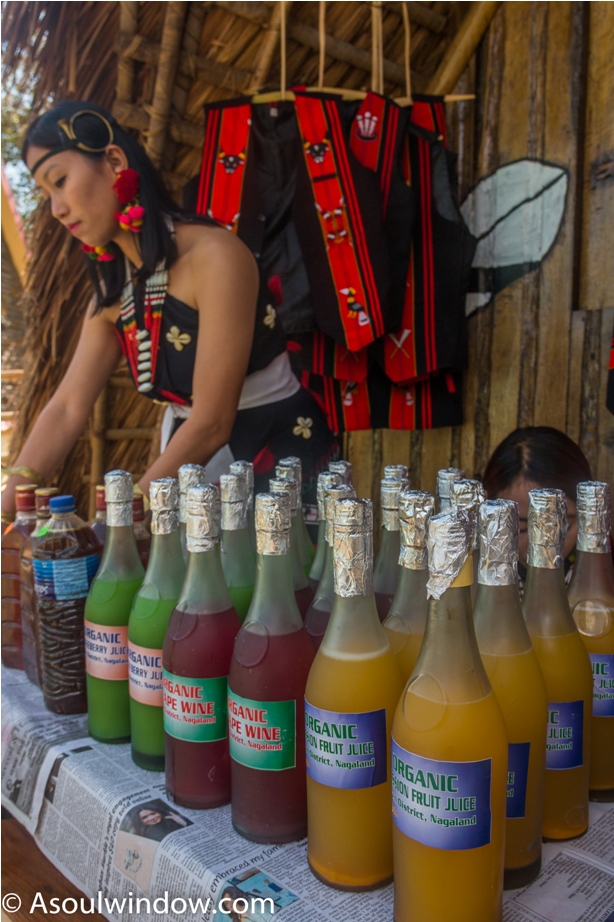
Organic fruit juices and wine for sale at Zeliang Morung. At Hornbill festival, Kisama. Near Kohima, Nagaland, India!
Spread the love, share this blog
Got any question/comments, ask in the comment section below so that it can benefit other readers.
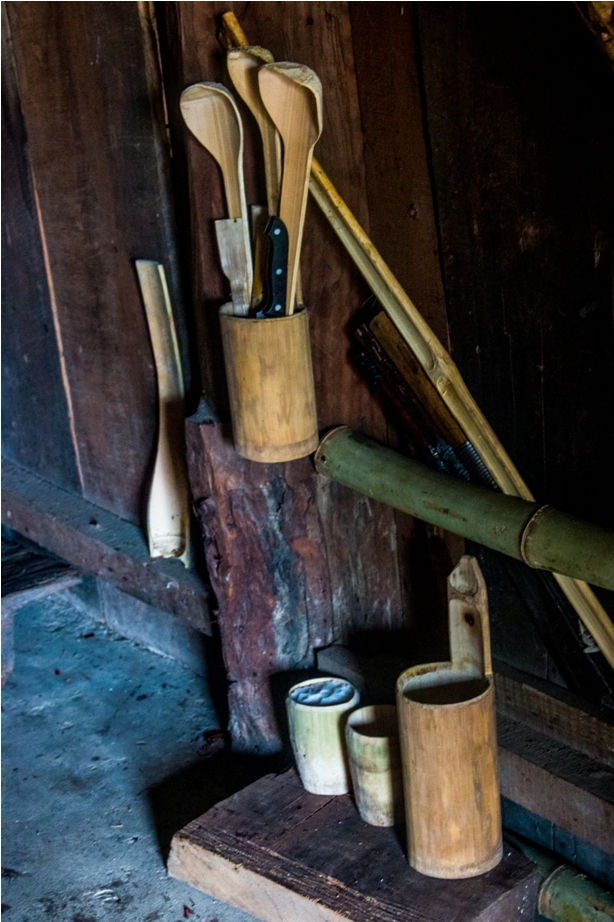
Eco Friendly bamboo utensils at Angami Morung. At Hornbill festival, Kisama. Near Kohima, Nagaland, India!
I bought vegan bamboo shoot pickle and Bhoot Jholakia chutney from shopping area. At Hornbill festival, Kisama. Near Kohima, Nagaland, India!
WARNING : COPYRIGHT TO ALL THE CONTENT SHARED HERE REMAINS WITH ME. THE IMAGES AND TEXT IN THIS BLOG ARE BY ME UNLESS MENTIONED OTHERWISE. YOU CAN NOT JUST LIFT THE CONTENT AND USE IT WITHOUT MY PERMISSION. STRICT LEGAL ACTION WILL BE TAKEN IF CONTENT IS STOLEN. YES, I AM SERIOUS.
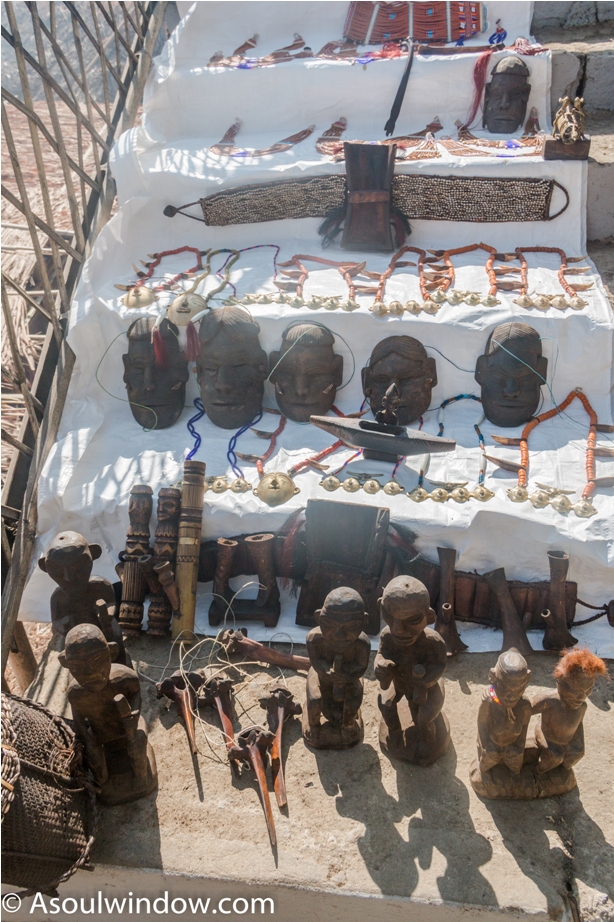
Local tribal jewelleries and handicrafts for sale at Hornbill festival, Kisama. Near Kohima, Nagaland, India!
11 thoughts on “COMPLETE GUIDE TO HORNBILL FESTIVAL, KISAMA NEAR KOHIMA – OFFBEAT NAGALAND, INDIA!”
Ayush
Lovely details and information about the Hornbill Festival Nagaland.
I want to know more about the accomodation there. I am planning to stay in a camp near the Kisama Village. How hard is it to get one if I book it once I reach there? I don’t want to take any tour packages
Thanks
I want to know more about the accomodation. How hard is it to get a camp near the Kisama village if I book it once I reach there? I don’t want to book any tour packages.
Simple & knowledgeable information for the people willing to add Hornbill in their adventure Bucket List. Must visit festival.It will reveal lots about the tribes & culture of the North-Eastern untouched regions.
Do visit North-East for much more unexplored beauties like this. Much more to explore..
If we could be of any assistance we’ll be glad to help being a North-Eastern. Thank you for this amazing blog.. 🙂
Thank you for reading. Yes, North East India does deserve more attention. Hornbill festival is one of its kind festival. I am planning a longer trip in coming months to North East India. Do follow me on Instagram at @asoulwindow to keep updated with my journey in North East India. I love this part of India.
Lovely details and information about the Hornbill Festival Nagaland.
I want to know more about the accomodation there. I am planning to stay in a camp near the Kisama Village. How hard is it to get one if I book it once I reach there? I don’t want to take any tour packages
Thanks
I want to know more about the accomodation. How hard is it to get a camp near the Kisama village if I book it once I reach there? I don’t want to book any tour packages.
Simple & knowledgeable information for the people willing to add Hornbill in their adventure Bucket List. Must visit festival.It will reveal lots about the tribes & culture of the North-Eastern untouched regions.
Do visit North-East for much more unexplored beauties like this. Much more to explore..
If we could be of any assistance we’ll be glad to help being a North-Eastern. Thank you for this amazing blog.. 🙂
Thank you for reading. Yes, North East India does deserve more attention. Hornbill festival is one of its kind festival. I am planning a longer trip in coming months to North East India. Do follow me on Instagram at @asoulwindow to keep updated with my journey in North East India. I love this part of India.
Having so much fun should be banned – favourite line! Wonderful read, brought back so many memories.
Haha. Yes. The kind of fun we had should be made illegal.. Wish it never ended though.
The complexity of India is amazing!
People forget how really diverse India is. ‘Love it!
True!
Thanks for the mention buddy in the post, it was fun connecting with you all and the lovely time and look forward to another trip with the gang!
Reblogged this on Srikanth's Traveldiaries and commented:
A lovely trip and time wellspent at the Hornbill Festival. Finely summarised by Abhinav.